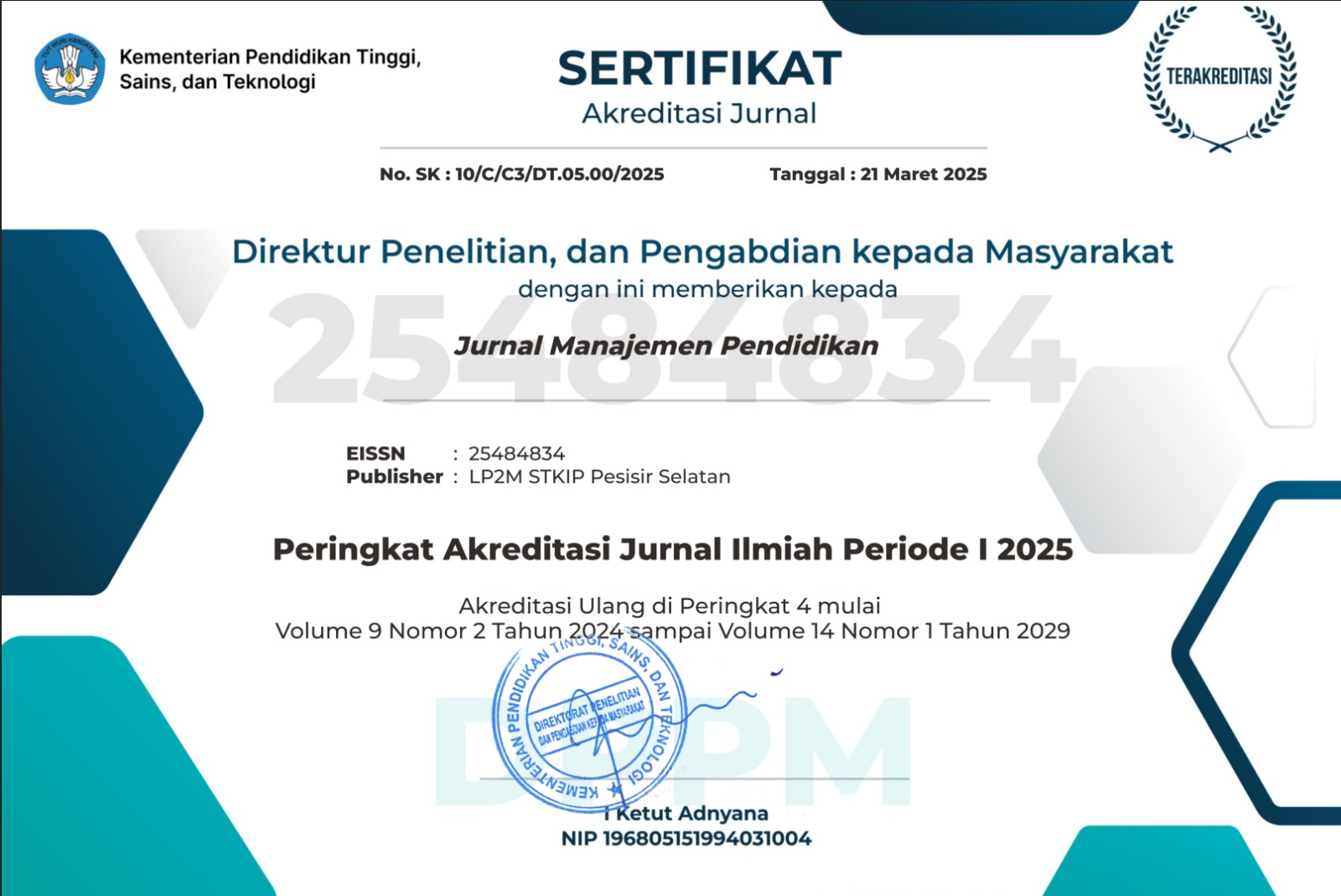
IMPLEMENTASI STRATEGI PEMBELAJARAN INOVATIF BERBASIS MEDIA DIGITAL DI ERA PENDIDIKAN MODERN DI UNIVERSITAS PGRI WIRANEGARA
DOI:
https://doi.org/10.34125/jmp.v11i1.1507Keywords:
Strategi pembelajaran, media digital, pendidikan modernAbstract
The development of digital technology demands that universities implement innovative learning strategies that are relevant to the needs of the modern education era. This study aims to describe and analyze the implementation of innovative digital media-based learning strategies at PGRI Wiranegara University. The study used a qualitative approach with a case study method. Data collection techniques included in-depth interviews with lecturers and students, observations of the learning process, and documentation studies. The results showed that the use of digital media such as learning management systems, learning videos, and interactive applications can increase student participation, learning flexibility, and material understanding. However, the implementation of these strategies still faces obstacles such as limited digital competence of some lecturers, infrastructure readiness, and variations in student learning motivation. This study concludes that innovative digital media-based learning strategies have the potential to improve learning quality if supported by strengthening lecturer capacity, adequate facilities, and sustainable institutional policies.
References
Adys, H. P., Sari, P. N., & Hamka, R. A. (n.d.). No Title.
Amelia, Y. (2023). Peran Kebudayaan Dalam Pembentukan Kesadaran Sosial Dan Lingkungan. JUPSI: Jurnal Pendidikan Sosial Indonesia, 1(1), 41–48. https://doi.org/10.62238/jupsijurnalpendidikansosialindonesia.v1i1.10
Dan, M., Belajar, P., Di, S., & Digital, E. R. A. (2025). Jurnal dinamika sosial dan sains. 428–431.
Digital, M., & Revolusi, D. A. N. (n.d.). 1) , 2) , 3).
Kuntari, S., & License, I. (2023). PROSIDING Vol.2 2023. 2, 90–94. https://doi.org/10.47435/sentikjar.v2i0.1826
Sejarah, P., & Sriwijaya, U. (2025). TRANSFORMASI PENDIDIKAN MODERN : PERAN ILMU PENDIDIKAN DALAM. 14, 2715–2723.
Seknum, M. F., Ambon, D. I., Ilmu, F., & Ambon, I. (2013). Jurnal Biology Science & Education 2013 m. faqih seknum. 2(2).
Tinggi, S., Islam, A., Bogor, D., & Digital, E. (2019). S p e d. 1(2), 308–318.
Trisiana, A. (2019). Jurnal Civics : Media Kajian Kewarganegaraan Model desain Pendidikan Kewarganegaraan di era media digital sebagai pendukung implementasi pendidikan karakter Jurnal Civics : Media Kajian Kewarganegaraan Model desain Pendidikan Kewarganegaraan di era media digital sebagai pendukung implementasi pendidikan karakter. 16(2), 154–164.
Adventyana, B. D., Salsabila, H., Sati, L., Galand, P. B. J., & Istiqomah, Y. Y. (2023). Media pembelajaran digital sebagai implementasi pembelajaran inovatif untuk sekolah dasar. Jurnal Pendidikan dan Konseling, 5(1), 3951–3955.
Ahmad, F. (2021). Pembelajaran berbasis proyek dalam meningkatkan keterampilan abad ke-21. Jurnal Pendidikan Inovatif, 6(2), 112–121.
Ali, M. R. N. R. (2025). Peran literasi digital dalam mendorong kemampuan berpikir siswa sekolah menengah atas: Kajian literatur terkini. Jurnal Riset dan Pengabdian Interdisipliner, 2(3), 590–602.
Anggreani, R. (2019). Strategi pembelajaran partisipatif dalam meningkatkan hasil belajar. Jurnal Pendidikan Humaniora, 7(1), 33–41.
Asghar, M. Z., Barberà, E., & Younas, I. (2021). Mobile learning technology readiness and acceptance among pre-service teachers during the COVID-19 pandemic. Knowledge Management & E-Learning, 13(1), 83–101.
Asrori, M. (2013). Psikologi pembelajaran. Bandung: Wacana Prima.
Bennett, L., Maton, K., & Kervin, L. (2008). The “digital natives” debate: A critical review of the evidence. British Journal of Educational Technology, 39(5), 775–786.
Bond, M., & Bedenlier, S. (2020). Research on student engagement and educational technology in higher education. International Journal of Educational Technology in Higher Education, 17(1), 1–24.
Boutarous, N. (2023). The role of distance learning in supporting student perseverance and a virtual learning environment. Proceedings of the International Conference on Learning and Teaching, 2119–2135.
Budiman, H. (2020). Implementasi blended learning dalam pendidikan tinggi. Jurnal Teknologi Pendidikan, 22(1), 45–56.
Cabero-Almenara, J., Guillén-Gámez, F. D., Ruiz-Palmero, J., & Palacios-Rodríguez, A. (2021). Digital competence of higher education professor according to DigCompEdu. Education and Information Technologies, 26(4), 4691–4708.
Cahyani, A. (2019). Motivasi belajar siswa dalam pembelajaran digital. Jurnal Pendidikan Modern, 4(2), 67–75.
Crawford, J. (2001). Distance education and globalization of teaching and learning. Open Learning, 16(2), 131–152.
Dang, T. D., Phan, T. T., Vu, T. N. Q., La, T. D., & Pham, V. K. (2024). Digital competence of lecturers and its impact on student learning value in higher education. Heliyon, 10(17), e37318.
Dewi, L. (2022). Lingkungan belajar dan motivasi intrinsik peserta didik. Jurnal Psikologi Pendidikan, 8(1), 55–63.
Diaz, A. F., & Estoque-Loñez, H. (2024). A meta-analysis on the effectiveness of gamification on student learning achievement. International Journal of Education in Mathematics, Science and Technology, 12(5), 1236–1253.
Dick, W., & Carey, L. (1986). The systematic design of instruction. New York: Harper Collins.
Fadhilah, N. (2021). Tantangan pembelajaran digital di era media sosial. Jurnal Pendidikan Kontemporer, 5(3), 201–210.
Fatimah, S. (2018). Strategi pembelajaran bahasa berbasis teknologi. Jurnal Pendidikan Bahasa, 6(2), 98–109.
Garrison, D. R., & Kanuka, H. (2004). Blended learning: Uncovering its transformative potential. The Internet and Higher Education, 7(2), 95–105.
Georgopoulou, M. S., Troussas, C., Krouska, A., & Sgouropoulou, C. (2025). Digital literacy in higher education. Computers, 14(12), 528.
Gilster, P. (1997). Digital literacy. New York: Wiley.
Indrawati, T. (2021). Hambatan implementasi teknologi dalam pembelajaran. Jurnal Manajemen Pendidikan, 13(2), 89–97.
Juwita, R. (2022). Pendekatan humanistik dalam pendidikan digital. Jurnal Pendidikan Karakter, 9(1), 23–31.
Kasih, R. (2021). Media pembelajaran digital berbasis video dan animasi. Jurnal Teknologi Pembelajaran, 4(2), 77–85.
Kozma, R. B. (2008). ICT, education reform, and economic growth. Handbook of Comparative Education. New York: Springer.
Krajcik, J., & Blumenfeld, P. (2006). Project-based learning. The Cambridge Handbook of the Learning Sciences. Cambridge: Cambridge University Press.
Lankshear, C., & Knobel, M. (2008). Digital literacy and digital literacies. Nordic Journal of Digital Literacy, 1(1), 12–24.
Margaryan, A., Bianco, M., & Littlejohn, A. (2015). Instructional quality of MOOCs. Computers & Education, 80, 77–83.
Mayer, R. E. (2009). Multimedia learning. Cambridge: Cambridge University Press.
Means, B., Toyama, Y., Murphy, R., Bakia, M., & Jones, K. (2009). Evaluation of evidence-based practices in online learning. Washington DC: U.S. Department of Education.
Moore, M. G. (1993). Theory of transactional distance. Handbook of Distance Education. New York: Routledge.
Nasir, F. D. M., Hussain, M. A., Mohamed, H., Mokhtar, M. A., & Karim, N. A. (2021). Student satisfaction in using LMS for blended learning. Asian Journal of University Education, 17(4), 1236–1253.
Novela, D., Suriani, A., & Nisa, S. (2024). Implementasi pembelajaran inovatif melalui media digital. Journal of Practice Learning and Educational Development, 4(2), 100–105.
OECD. (2019). Going digital: Shaping policies, improving lives. Paris: OECD Publishing.
OECD. (2021). Education at a glance 2021. Paris: OECD Publishing.
Pribadi, B. A. (2009). Model desain sistem pembelajaran. Jakarta: Dian Rakyat.
Rehman, N., Huang, X., Mahmood, A., AlGerafi, M. A., & Javed, S. (2024). Project-based learning as a catalyst for 21st-century skills. Heliyon, 10(23), e39988.
Salmon, G. (2011). E-tivities: The key to active online learning. London: Routledge.
Sanjaya, W. (2008). Strategi pembelajaran berorientasi standar proses pendidikan. Jakarta: Kencana.
Seels, B. B., & Richey, R. C. (1994). Instructional technology. Washington DC: AECT.
Siemens, G. (2005). Connectivism: A learning theory for the digital age. International Journal of Instructional Technology and Distance Learning, 2(1), 3–10.
UNESCO. (2018). ICT competency framework for teachers. Paris: UNESCO.
UNESCO. (2021). Reimagining our futures together. Paris: UNESCO.
Zou, Y., Kuek, F., Feng, W., & Cheng, X. (2025). Digital learning in the 21st century. Frontiers in Education, 10, 1562391.