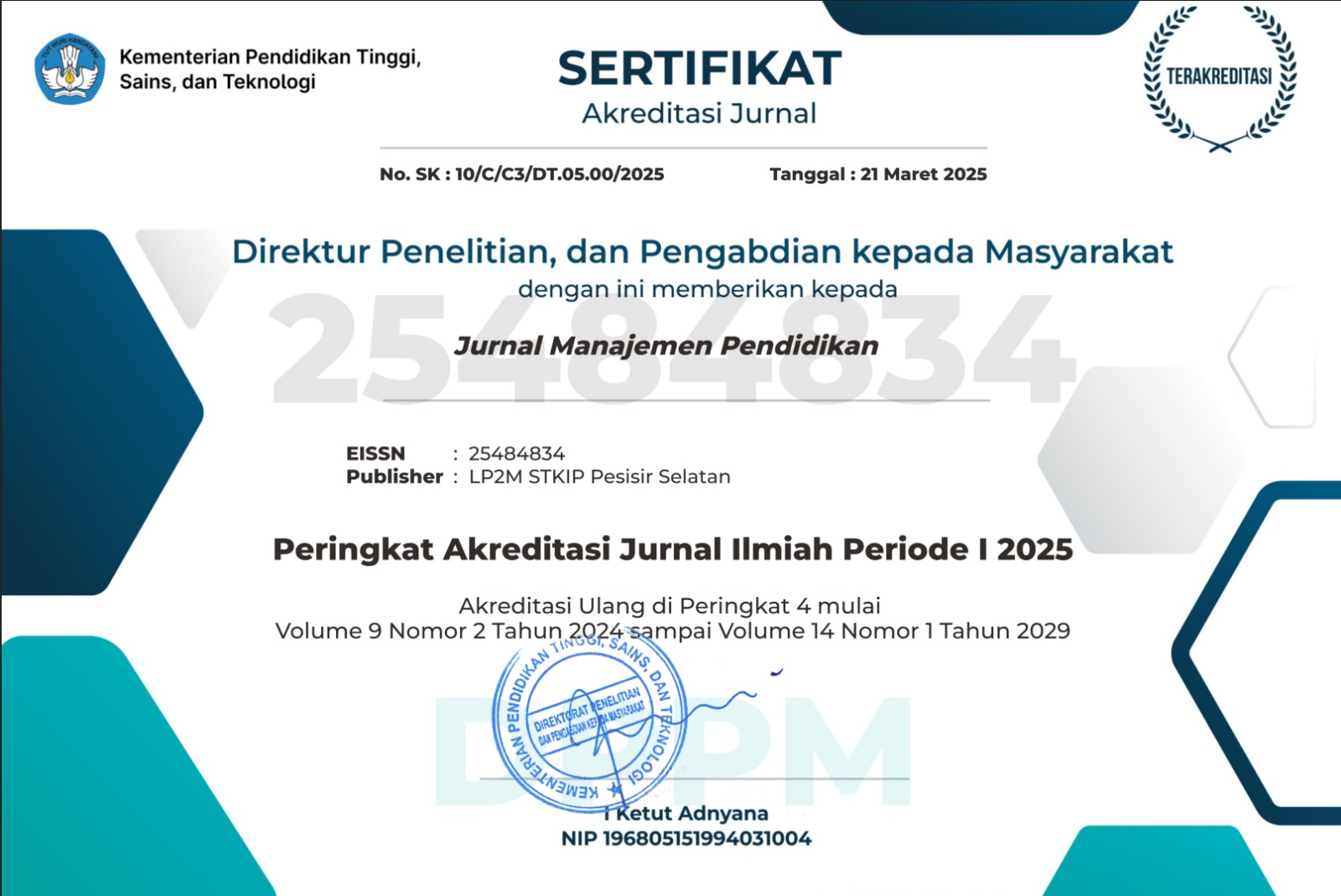
ANALISIS HUBUNGAN PELAKSANAAN PROGRAM MAKAN BERGIZI GRATIS TERHADAP MOTIVASI BELAJAR SISWA MTSN 12 PESISIR SELATAN
DOI:
https://doi.org/10.34125/jmp.v10i4.1519Keywords:
Makan Bergizi Gratis, Motivasi BelajarAbstract
Motivation to learn is important in educational success. Motivation to learn is not only influenced by psychological factors, but also by physical condition, including nutritional intake. More than 50% of MTsN 12 Pesisir Selatan students do not eat breakfast before going to school. This has a negative impact on students' physical and psychological readiness, energy, enthusiasm for learning, activeness and persistence in the learning process at school. As an effort to overcome this problem, the Indonesian government has implemented a Free Nutritious Meal (MBG) program for school children. This research aims to find out whether there is a relationship between the MBG program and the learning motivation of MTsN 12 Pesisir Selatan students. This research uses a quantitative approach with Correlation Analysis and Simple Linear Regression Test. The research population was all MTsN 12 Pesisir Selatan students, with samples selected based on stratified random sampling of 30 students. The research results show that there is a strong and significant positive relationship between the MBG Program and student learning motivation with a value of r = 0.912. This means that the better the implementation of the MBG program, the higher the student's learning motivation
References
Adolphus, K., Lawton, C. L., & Dye, L. (2013). The effects of breakfast on behavior and academic performance in children and adolescents. Frontiers in Human Neuroscience, 7, 425.
Arikunto, S. (2010). Dasar-dasar evaluasi pendidikan. Bumi Aksara.
Ariningtyas, D. (2025). Efektivitas dan tantangan kebijakan Program Makan Bergizi Gratis sebagai intervensi pendidikan di Indonesia. Jurnal Kebijakan Pendidikan, 12(1), 45–58. Diakses 2 Desember 2025
Baumeister, R. F. (2011). Willpower: Rediscovering the greatest human strength. Penguin Books.
Benton, D. (2008). Micronutrient status, cognition and behavioral problems in childhood. European Journal of Nutrition, 47(3), 38–50. Diakses 2 Desember 2025
Benton, D. (2010). The influence of dietary status on the cognitive performance of children. Molecular Nutrition & Food Research, 54(4), 457–470.
Benton, D., & Donohoe, R. (1999). The effects of nutrients on mood. Public Health Nutrition, 2(3A), 403–409.
Bryan, J., Osendarp, S., Hughes, D., Calvaresi, E., Baghurst, K., & van Klinken, J. W. (2004). Nutrients for cognitive development in school-aged children. Nutrition Reviews, 62(8), 295–306.
Budd, G., Bhaskaran, M., & Mason, K. (2019). School meal programs and student nutrition: A review. Journal of Child Nutrition and Health, 45(2), 101–110.
Contento, I. R. (2011). Nutrition education: Linking research, theory, and practice (2nd ed.). Jones & Bartlett Learning.
Deci, E. L., & Ryan, R. M. (2000). Self-determination theory: Basic psychological needs in motivation, development, and wellness. Guilford Press.
Florence, M. D., Asbridge, M., & Veugelers, P. J. (2008). Diet quality and academic performance. Journal of School Health, 78(4), 209–215. Diakses 22 November 2025.
Fredricks, J. A., Blumenfeld, P. C., & Paris, A. H. (2004). School engagement: Potential of the concept, state of the evidence. Review of Educational Research, 74(1), 59–109.
Gailliot, M. T., & Baumeister, R. F. (2007). The physiology of willpower: Linking blood glucose to self-control. Personality and Social Psychology Review, 11(4), 303–327.
Gibson, R. S. (2013). Principles of nutritional assessment (2nd ed.). Oxford University Press.
Grantham-McGregor, S., & Ani, C. (2001). A review of studies on the effect of iron deficiency on cognitive development in children. The Journal of Nutrition, 131(2), 649S–666S. Diakses 20 November 2025.
Grantham-McGregor, S., Cheung, Y. B., Cueto, S., Glewwe, P., Richter, L., & Strupp, B. (2007). Developmental potential in the first 5 years for children in developing countries. The Lancet, 369(9555), 60–70. https://doi.org/10.1016/S0140-6736(07)60032-4
Hanim, I. (2022). Psikologi belajar (E-book). Universitas Malaysia Terengganu.
Hendrilia, Y., Salamah, S., Judijanto, L., Nuryenda, E. Y., & Fauzi, M. S. (2025). Learning motivation as a predictor of academic success: A literature review in educational psychology. TOFEDU: The Future of Education Journal, 4(6), 1841–1846. Diakses 22 November 2025.
Jensen, E. (2005). Teaching with the brain in mind. ASCD.
Kristjansson, E. A., Robinson, V., Petticrew, M., MacDonald, B., Krasevec, J., Janzen, L., & Shea, B. (2016). School feeding for improving the physical and psychosocial health of disadvantaged elementary school children. Cochrane Database of Systematic Reviews, 2016(8), CD004676.
Lestari, S., & Ramadhan, Y. (2025). Pengaruh Program Makan Bergizi Gratis terhadap minat belajar dan kehadiran siswa sekolah dasar. Jurnal Pendidikan Anak, 9(2), 112–125. Diakses 2 Desember 2025.
Maslow, A. H. (1987). Motivation and personality (3rd ed.). Harper & Row.
Nurjan, S. (2016). Psikologi belajar. Universitas Muhammadiyah Ponorogo.
Pollitt, E. (1995). Poor nutrition and impaired mental development. Scientific American, 272(2), 38–43.
Pollitt, E., & Mathews, R. (1998). Breakfast and cognition: An integrative summary. American Journal of Clinical Nutrition, 67(4), 804S–813S.
Putri, F. (2025). Efektivitas Program Makan Bergizi Gratis terhadap minat belajar anak usia dini. Jurnal Aura Pendidikan, 6(1), 14–27.
Rampersaud, G. C., Pereira, M. A., Girard, B. L., Adams, J., & Metzl, J. D. (2005). Breakfast habits, nutritional status, body weight, and academic performance in children and adolescents. Journal of the American Dietetic Association, 105(5), 743–760.
Rahmawati, M. (2025). Tinjauan nilai gizi Program Makan Bergizi Gratis (MBG) Presiden RI. Gizi dan Kesehatan Terapan, 13(1), 22–34.
Ryan, R. M., & Deci, E. L. (2000). Self-determination theory and the facilitation of intrinsic motivation. American Psychologist, 55(1), 68–78.
Santoso, D., & Anjani, R. (2020). Pengaruh program makan bergizi terhadap keaktifan belajar siswa SD. Jurnal Pendidikan dan Kesehatan, 8(2), 55–64.
Schunk, D. H., Pintrich, P. R., & Meece, J. L. (2014). Motivation in education: Theory, research, and applications (6th ed.). Pearson.
Slavin, R. E. (2018). Educational psychology: Theory and practice (13th ed.). Pearson.
World Health Organization. (2008). Worldwide prevalence of anaemia 1993–2005: WHO global database on anaemia. WHO Press.
Zimmerman, B. J. (2002). Becoming a self-regulated learner: An overview. Theory Into Practice, 41(2), 64–70.