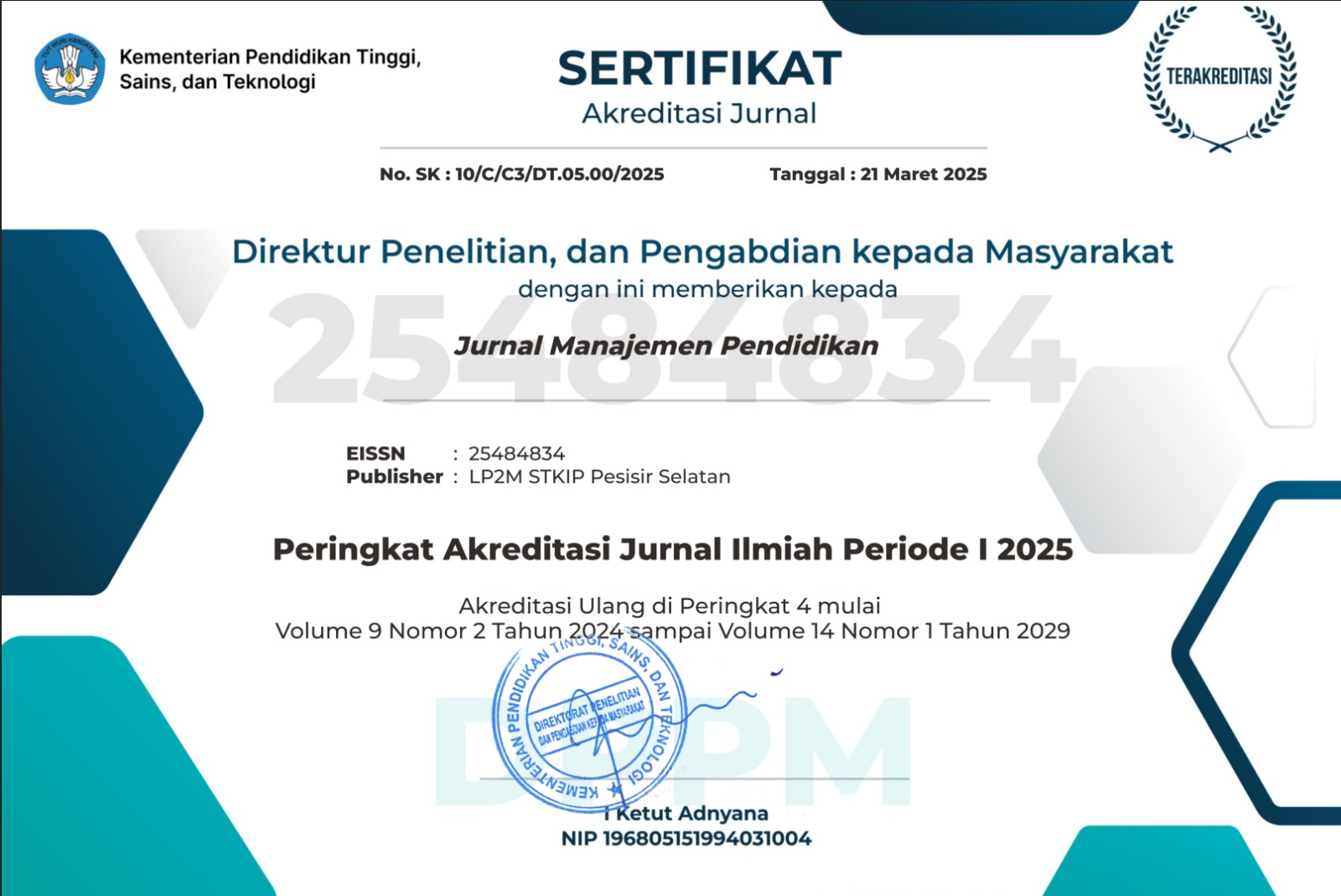
KAJIAN DIGITAL ETHOS PIMPINAN MADRASAH DAN DAMPAKNYA PADA MUTU LAYANAN ADMINISTRASI PENDIDIKAN ISLAM
DOI:
https://doi.org/10.34125/jmp.v11i1.1641Keywords:
Digital Ethos Pimpinan; Mutu Layanan Administrasi; Pendidikan IslamAbstract
This study aims to analyze the role of school leaders’ digital ethos and its impact on the quality of Islamic education administrative services in the context of digital transformation. The research was conducted at MTs Al-Amiriyah as a representative case of a madrasa developing digital-based administrative services amid limited technological infrastructure. A qualitative approach with a case study design was employed. Data were collected through in-depth interviews, participatory observations, and document studies involving the head of the madrasa, administrative staff, teachers, and service users. The data were thematically analyzed using triangulation techniques to ensure the validity of the findings. The results indicate that the digital ethos of school leaders is a more decisive factor in improving the quality of administrative services than the mere availability of technological infrastructure. Leaders with a strong digital ethos are able to transform work culture, optimize the use of limited technology, and shift the role of administrative staff from procedural tasks to user-oriented services. Furthermore, the integration of digital ethos with Islamic leadership values such as trustworthiness (amanah), honesty, justice, deliberation (musyawarah), and sincerity produces a value-based digital transformation model that strengthens ethics, accountability, and user satisfaction.
References
Alabi, M. (2025). Organizational Culture and Its Impact on Technology Adoption and Business Agility. February.
Ali, M., Publik, A., Pembangunan, U., & Veteran, N. (2025). Implementasi Kebijakan Indonesia Digital Dalam Mewujudkan Integrasi Teknologi Pelayanan Publik The Implementation of Indonesia Digital Policy in Realizing the Integration of Public Service Technology government technology INA Digital yang Widodo ( KEMENPAN RB , 2024 ). Kebijakan. 1(2). https://doi.org/10.36762/jpd.v1i2.1286
Bengtson, E., & Finlayson, A. (n.d.). The Virtues of Green Marketing A Constructive Take on Corporate Rhetoric.
Cheng, Z., Jin, X., & Kwak, W. J. (2025). Using the new positive aspect of digital leadership to improve organizational sustainability: Testing moderated mediation model. Acta Psychologica, 255, 104963. https://doi.org/https://doi.org/10.1016/j.actpsy.2025.104963
Code, L. (n.d.). The Role of Digital Leadership and Organizational Capabilities for Innovation and Institutional Collaboration for Knowledge Creation : -Towards Ethiopian Third Generation Universities.
Di, A., & Tinggi, P. (2025). UNIVERSITAS MUHAMMADIYAH JAMBI Page 161 of 202. 13(1), 161–173.
López-figueroa, J. C., Ochoa-jiménez, S., Palafox-soto, M. O., Sujey, D., & Munoz, H. (2025). Digital Leadership : A Systematic Literature Review. 1–22.
Özkan Alakaş, E. (2024). Digital transformational leadership and organizational agility in digital transformation: Structural equation modelling of the moderating effects of digital culture and digital strategy. The Journal of High Technology Management Research, 35(2), 100517. https://doi.org/https://doi.org/10.1016/j.hitech.2024.100517
Pereira, M. S., Carlos, S., Powell, D. J., Faria, S., & Magalh, M. (2024). administrative sciences Digital Culture , Knowledge , and Commitment to Digital Transformation and Its Impact on the Competitiveness of Portuguese Organizations.
Popli, S. (2017). Leadership style and service orientation : the catalytic role of employee engagement. https://doi.org/10.1108/JSTP-07-2015-0151
Purnomo, Y. J., Muna, A., & Ausat, A. (2024). The Role of Value-Based Leadership in Shaping an Organizational Culture that Supports Sustainable Change. 2(1), 430–435.
Retnowati, C. N., & Santosa, B. (2023). Enrichment : Journal of Multidisciplinary Research and Development Digital Leadership , Culture & Employee Capabilities : Sustainable Organizational. 1(6), 257–265.
Sacavém, A., Machado, A. D. B., & Palma-moreira, A. (2025). Leading in the Digital Age : The Role of Leadership in Organizational Digital Transformation. 1–21.
Wakhyuni, E., & Setiawan, A. (2025). The Role Of Employee Engagement & Digital Leadership In Enhancing Service Quality Of Public Service In Rural Goverment Peran Employee Engagement Dan Kepemimpinan Digital Dalam Meningkatkan Kualitas Pelayanan Publik Di Pemerintahan Daerah Pedesaan. 4(2), 1055–1064.
Yi, H.-T., Lee, M., & Park, K. (2022). Service Orientation and Customer Performance: Triad Perspectives of Sales Managers, Sales Employees, and Customers. Behavioral Sciences (Basel, Switzerland), 12(10). https://doi.org/10.3390/bs12100373
Yuan, M., Cai, W., Gao, X., & Fu, J. (n.d.). How Servant Leadership Leads to Employees ’ Customer-Oriented Behavior in the Service Industry ? A Dual-Mechanism Model.