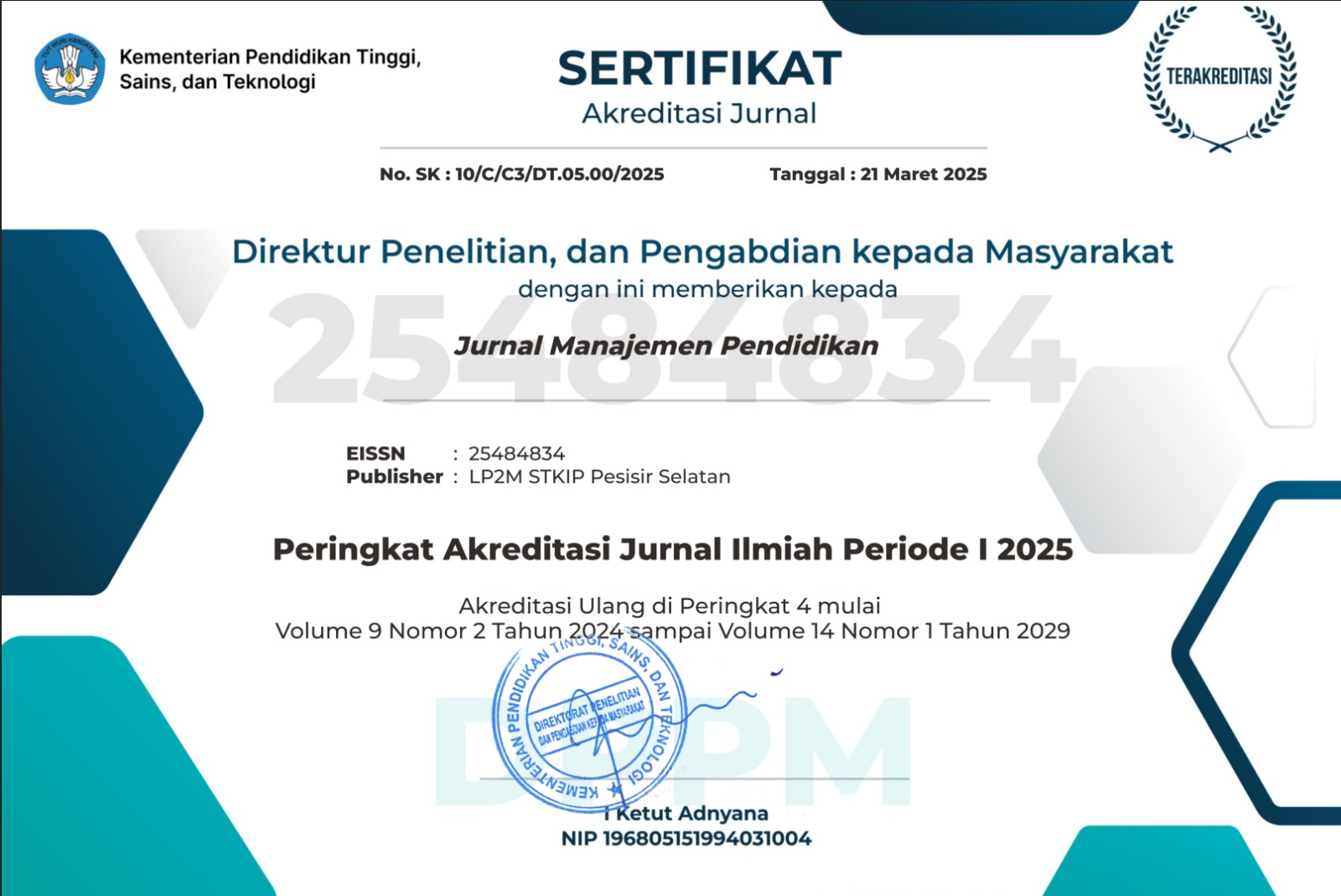
REVITALISASI PENDIDIKAN ISLAM BERBASIS KETELADANAN SULTAN AL-FATIH DI ERA MODERN
DOI:
https://doi.org/10.34125/jmp.v11i2.2044Keywords:
Islamic education, Islamic civilization, Sultan Al-Fatih, leadershipAbstract
Objective: The abstract is important because many journal readers read the abstract first to determine whether the entire article is worth reading. The abstract is a shortened version of the paper and should contain all the information the reader needs to determine: (1) what the purpose of the study was; (2) how the study was conducted; (3) what results were obtained; (4) and Novelty. Methods: The abstract is important because many journal readers read the abstract first to determine whether the entire article is worth reading. Results: The abstract is important because many journal readers read the abstract first to determine whether the entire article is worth reading. The abstract is a shortened version of the paper and should contain all the information the reader needs to determine: (1) what the purpose of the study was; (2) how the study was conducted; (3) what results were obtained; (4) and Novelty. Novelty: The abstract is important because many journal readers read the abstract first to determine whether the entire article is worth reading. The abstract is a shortened version of the paper and should contain all the information the reader needs to determine: (1) what the purpose of the study was; (2) how the study was conducted; (3) what results were obtained; (4) and Novelty. The abstract can be 150 – 250 words.
References
Abbas, N., Rochmawan, A. E., Fathurrohman, M., & Ulfah, Y. F. (2024). Implementasi Metode Keteladanan Rasulullah Dalam Kurikulum Pendidikan Agama Islam Telaah Pemikiran Abdul Fattah Abu Ghuddah. Mamba'ul'Ulum, 72-89. doi:https://doi.org/10.54090/mu.329
Abiyusuf, I., Hafizi, M., Pakhrurrozi, P., Saputra, W., & Hermanto, E. (2024). Critical Analysis of The Rejection of Richard Bell’s Thoughts on The Translation of The Qur’an in The Context of Orientalism. INJIES: Journal of Islamic Education Studies, 1(2), 48–60. https://doi.org/10.34125/injies.v1i2.6
Al-Munyawi, S. R. (2012). Muhammad Al-Fatih: Penakluk Konstantinopel: Pustaka Al-Kautsar.
Arifian, A. (2020). Sejarah Lengkap Dunia Abad Pertengahan 500-1400 M: Dari Pemberontakan Odoacer Hingga Runtuhnya Sintesis Thomisme: Anak Hebat Indonesia.
Arifianto, A., & Purnomo, M. S. (2024). The Role of Marketing Management in The Development of Islamic Education Services. JERIT: Journal of Educational Research and Innovation Technology, 1(2), 112–122. https://doi.org/10.34125/jerit.v1i2.14
Atlis, L. D., & Afandi, M. (2024). Reformasi Pendidikan Islam Pada Masa Sultan Mahmud II (1808-1839 M). Jurnal Pendidikan Tambusai, 8(1), 5529-5537.
Ayuba, J. O., Abdullateef, L. A., & Mutathahirin, M. (2025). Assessing the Utilization of Information and Communication Technology (ICT) Tools for Teaching Secondary Schools Islamic Studies in Ilorin, Nigeria. JERIT: Journal of Educational Research and Innovation Technology, 2(1), 28–37. https://doi.org/10.34125/jerit.v2i1.22
Aziz, M., ‘Arif, M., Alwi, M. F., & Nugraha, M. N. (2024). Improving The Quality of Education Through Optimizing the Educational Administration System at The An-Nur Islamic Education Foundation. INJIES: Journal of Islamic Education Studies, 1(1), 5–15. https://doi.org/10.34125/injies.v1i1.2
Baroud, N., Alouzi, K., Elfzzani, Z., Ayad, N., & Albshkar, H. (2024). Educators’ Perspectives on Using (AI) As A Content Creation Tool in Libyan Higher Education: A Case Study of The University of Zawia. JERIT: Journal of Educational Research and Innovation Technology, 1(2), 61–70. https://doi.org/10.34125/jerit.v1i2.12
Casale, G. (2022). Mehmed the Conqueror between Sulh-i Kull and Prisca Theologia. Modern Asian Studies, 56(3), 840-869.
Creswell, J. W., & Creswell, J. D. (2017). Research design: Qualitative, quantitative, and mixed methods approaches: Sage publications.
Freely, J. (2019). Istanbul: Ibu Kota Tiga Imperium Agung Dunia (Byzantium, Romawi, dan Usmani): Pustaka Alvabet.
Günergun, F. (2025). A Turkish Sultan in quest for knowledge: Mehmed II's patronage of science and scholars in fifteenth century Istanbul. Journal of Astronomical History and Heritage, 28(2), 400.
Gusnarib, G., & Adawiyah, S. R. (2024). Pendidikan dan Peradaban. Prosiding Kajian Islam dan Integrasi Ilmu di Era Society (KIIIES) 5.0, 3(1), 33-41.
Hamami, T., & Nuryana, Z. (2022). A holistic–integrative approach of the Muhammadiyah education system in Indonesia. HTS Teologiese Studies/Theological Studies, 78(4), 7607.
Hamid, S. B. A., Syarif, N. Q., & Ratu, R. (2025). Penaklukan Konstantinopel di Bawah Kepemimpinan Sultan Mahmud II (Kajian Ilmu Pendidikan Islam). El-Fata: Journal of Sharia Economics and Islamic Education, 4(1), 99-10.
Hanafi, Y., Taufiq, A., Saefi, M., Ikhsan, M. A., Diyana, T. N., Thoriquttyas, T., & Anam, F. K. (2021). The new identity of Indonesian Islamic boarding schools in the “new normal”: the education leadership response to COVID-19. Heliyon, 7(3).
Hasbi, B., & Angkasa, M. A. (2025). Constructing a Universal Ruler: Sultan Mehmet II and Hybrid Legitimacies of the Ottoman Empire. International Journal of Islamic Khazanah, 15(1), 22-35. doi:https://doi.org/10.15575/ijik.v15i1.49982
Herawati, A., Sinta, P. D., Marati, S. N., & Sari, H. P. (2025). Peran pendidikan Islam dalam membangun karakter generasi muda di tengah arus globalisasi. IHSAN: Jurnal Pendidikan Islam, 3(2), 370-380. doi:https://doi.org/10.61104/ihsan.v3i2.987
Hidayati, E., & Hutagaol, B. A.-R. (2025). An Analysis of Hasan Hanafi’s Tafsir Method: Hermeneutics as An Interpretative Approach. INJIES: Journal of Islamic Education Studies, 2(1), 39–48. https://doi.org/10.34125/injies.v2i1.22
Iskandar, M. Y., Nugraha, R. A., Halimahturrafiah, N., Amarullah, T. A. H., & Putra, D. A. (2024). Development of Android-Based Digital Pocketbook Learning Media in Pancasila and Citizenship Education Subjects For Class VIII SMP . JERIT: Journal of Educational Research and Innovation Technology, 1(2), 51–60. https://doi.org/10.34125/jerit.v1i2.13
Miles, M. B., & Huberman, A. M. (1994). Qualitative data analysis: An expanded sourcebook: sage.
Munif, M. V. M. (2024). Sejarah Kepemimpinan Transformasional. Dar El-Ilmi: Jurnal Studi Keagamaan, Pendidikan Dan Humaniora, 11(2), 145-158. doi:https://doi.org/10.52166/darelilmi.v11i2.7911
Nugraha, R. A., & Iskandar, M. Y. (2024). Development of Video Tutorials as A Media for Learning Graphic Design in Vocational High Schools. JERIT: Journal of Educational Research and Innovation Technology, 1(1), 1–11. https://doi.org/10.34125/jerit.v1i1.1
Nuryana, Z. (2022). Academic reform and sustainability of Islamic higher education in Indonesia. International Journal of Educational Development, 89, 102534.
Oktavia, E. D., Romdani, R., & Wijaya, W. R. (2025). Dinamika Pendidikan Islam di Madrasah sebagai Pusat Peradaban. Al-Fawwaz: Jurnal Ilmiah Pendidikan dan Kemasyarakatan, 1(1), 16-26.
Ramadoni, M. D. (2022). Pembaruan Strategi Militer Muhammad Al-Fatih Dalam Penaklukan Konstantinopel. Tanjak: Sejarah dan Peradaban Islam, 2(3), 266-281. doi:https://doi.org/10.19109/tanjak.v2i3.14026
Ruskandi, K., Pratama, E. Y., & Asri, D. J. N. (2021). Transformasi Arah Tujuan Pendidikan di Era Society 5.0: CV. Caraka Khatulistiwa.
Sugiyono. (2016). Metode penelitian kuantitatif, kualitatif dan R&D. Alfabeta, Bandung.
Suryadi, A. (2024). Dinamika Pendidikan Islam: Perspektif Historis Dan Tantangan Modern: CV Jejak (Jejak Publisher).
Syafar, D. (2017). Teori kepemimpinan dalam lembaga pendidikan islam. Tadbir: Jurnal Manajemen Pendidikan Islam, 5(1), 147-155. https://doi.org/10.30603/tjmpi.v5i1.524
Syafii, M. H., Rahmatullah, A. . S., Purnomo, H., & Aladaya, R. (2025). The Correlation Between Islamic Learning Environment and Children’s Multiple Intelligence Development. INJIES: Journal of Islamic Education Studies, 2(1), 29–38. https://doi.org/10.34125/injies.v2i1.17
Thahir, L. S., Nurdin, H., Sos, S., Amin, S. M., Nur, M. D. M., PFis, M., & Ahsan, M. N. (2026). Studi Integrasi Ilmu: Divya Media Pustaka.
Wathoni, L. M. N. (2018). Integrasi Pendidikan Islam dan Sains: Rekonstruksi Paradigma Pendidikan Islam: Uwais Inspirasi Indonesia.
Wiyono, D. F. (2017). Pemikiran pendidikan Islam: Konseptualisasi pendidikan karakter dalam perspektif intelektual Islam klasik. Nidhomul Haq: Jurnal Manajemen Pendidikan Islam, 2(3), 164-179. doi:https://doi.org/10.31538/ndh.v2i3.180
Zed, M. (2008). Metode penelitian kepustakaan: Yayasan Pustaka Obor Indonesia.