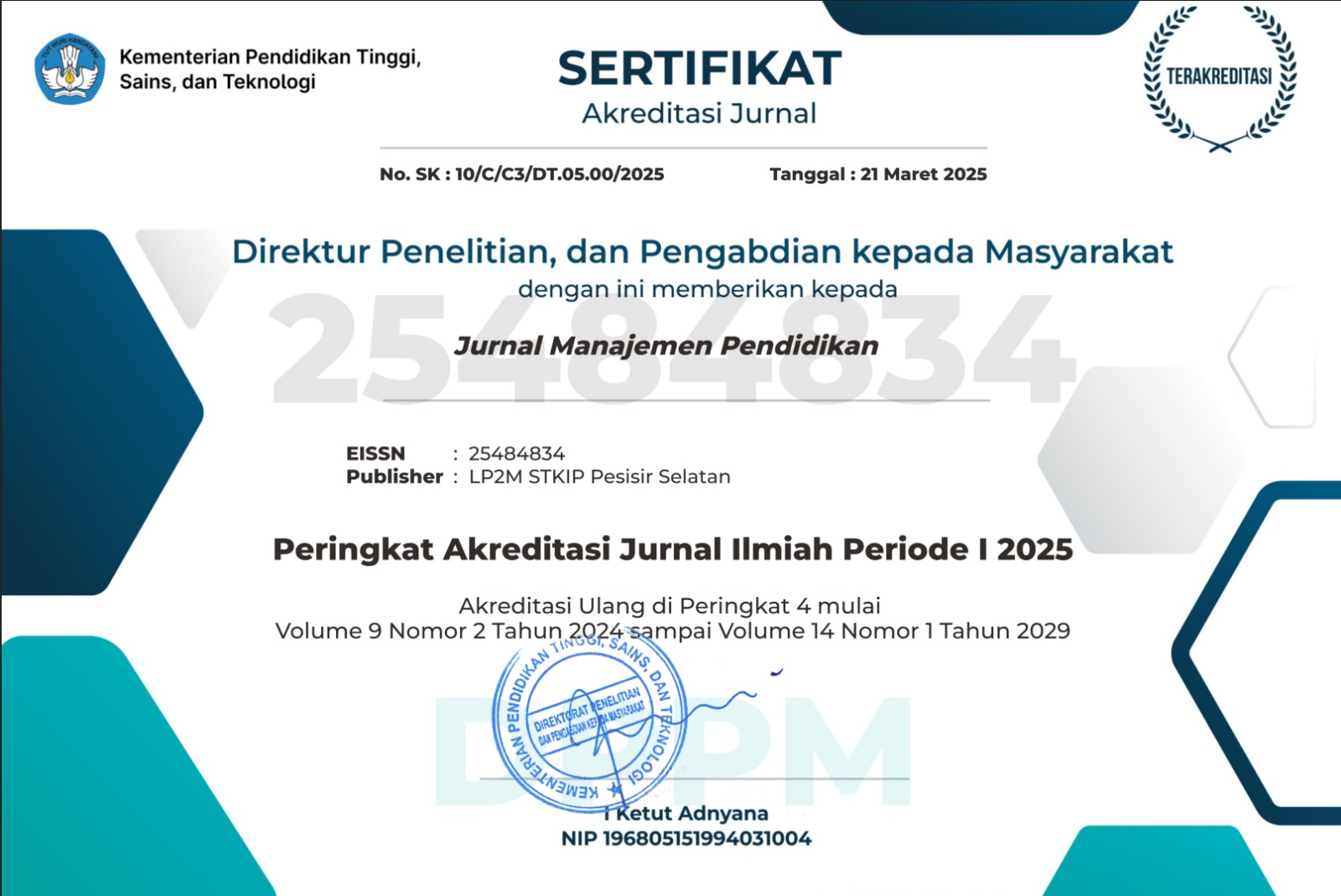
DETERMINAN MINAT STUDI LANJUT KE PERGURUAN TINGGI SISWA SMK BEZAB KECAMATAN KWANYAR KABUPATEN BANGKALAN
DOI:
https://doi.org/10.34125/jmp.v11i3.2277Keywords:
Dukungan Orang Tua, Motivasi Intrinsik Dan Ekstrinsik, Self-Efficacy, Minat Pendidikan Tinggi, SMKAbstract
This research is based on students' interest in deciding to study at university. Various studies show that students' interest in studying at university is still low, there are several major considerations related to the decision to continue studying or not. Bani Zainal Abidin Islamic Boarding School is a non-formal Islamic institution located in Kwanyar District, Bangkalan Regency. There are 4 major categories: Career considerations, school achievements, social environment, and internal decisions. This study uses an associative quantitative approach to examine the influence of four factors on the interest of SMK Bezab students to continue their studies. The sample was selected purposively. Variables were measured through a 1–5 Likert scale questionnaire and analyzed using multiple linear regression or ordinal logistic regression. The results show that partially, all independent variables, namely job prospect considerations (X1), academic achievement (X2), social influence (X3), and decision-making process (X4) have a significant effect on students' interest in continuing their studies at university (Y), with each calculated t value greater than the t table (X1 = 10.389; X2 = 6.194; X3 = -4.567). Simultaneously, the four factors also have a significant effect (F count = 217.959>F table = 2.77; p = 0.000), with a contribution of 92% (R² = 0.92).
References
A. Bandura, Prentice-Hall series in social learning theory. Social foundations of thought and action: A social cognitive theory. Prentice-Hall, Inc., 1985.
A. L. Dent and A. C. Koenka, “The relation between self-regulated learning and academic achievement across childhood and adolescence: a meta-analysis,” Educ. Psychol. Rev., vol. 28, no. 3, pp. 425–474, 2015, doi: 10.1007/s10648-015-9320-8.
A. M. Flanagan, D. C. Cormier, and O. Bulut, “Achievement may be rooted in teacher expectations: examining the differential influences of ethnicity, years of teaching, and classroom behaviour,” Soc. Psychol. Educ., vol. 23, pp. 1429–1448, 2020, doi: 10.1007/s11218-020-09590-y.
Abelha, M. et al. (2020). Graduate Employability and Competence Development in Higher Education—A Systematic Literature Review Using PRISMA. Sustainability, 12(15):5900. https://doi.org/10.3390/su12155900.
Akhtar, H. (2020). Rumus Slovin untuk Menentukan Jumlah Sampel dan Kontroversinya. Semesta Psikometrika. https://www.semestapsikometrika.com/2020/02/rumus-slovin-untuk-menentukan-jumlah.html.
Anjeli Anjeli, Anora Rezky Mulia, Sani Safitri and Yudi Pratama, "Analisis Faktor- faktor yang Mempengaruhi Rendahnya Minat Siswa Untuk Melanjutkan Pendidikan ke Perguruan Tinggi", Historis |FKIP UMMat 9, no.1 (Universitas Muhammadiyah Mataram, 2024): 35, ISSN 2614-1167, https://doi.org/10.31764/historis.v9i1.20411.
Alexandro, R., Putri, W. U., Uda, T., & Oktaria M (2021). Faktor-Faktor yang Mempengaruhi Minat Lulusan SMK di Kecamatan Kamipang Melanjutkan Pendidikan ke Perguruan Tinggi. Jurnal Pendidikan, 22(1), 63–85. https://doi.org/10.52850/jpn.v22i1.3329.
B. J. Zimmerman and A. R. Moylan, “Self-regulation: where metacognition and motivation intersect,” in Handbook of Metacognition in Education, 2009, pp. 299–315.
E. H. Mahvelati, “Learners’ perceptions and performance under peer versus teacher corrective feedback conditions,” Stud. Educ. Eval., vol. 70, 2021, doi: 10.1016/j.stueduc.2021.100995.
F. Baier, A.-T. Decker, T. Voss, T. Kleickmann, U. Klusmann, and M. Kunter, “What makes a good teacher? The relative importance of mathematics teachers’ cognitive ability, personality, knowledge, beliefs, and motivation for instructional quality,” Br. J. Educ. Psychol., vol. 89, no. 4, pp. 767–786, 2019, doi: 10.1111/bjep.12256.
F. M. van der Kleij, “Comparison of teacher and student perceptions of formative assessment feedback practices and association with individual student characteristics,” Teach. Teach. Educ., vol. 85, no. 1, pp. 175–189, 2019.
F. Reichert, D. Lange, and L. Chow, “Educational beliefs matter for classroom instruction: A comparative analysis of teachers’ beliefs about the aims of civic education,” Teach. Teach. Educ., vol. 98, pp. 1–13, 2020, doi: 10.1016/j.tate.2020.103248.
Faisal, M.A (2018). Skripsi Analisis Keputusan Lulusan Sekolah Menengah Kejuruan Melanjutkan Studi Di Fakultas Ekonomi Universitas Negeri Yogyakarta. http://eprints.uny.ac.id/id/eprint/59651.
Fani, J., Subaogo, N & Rahayu, V. P (2022). Analisis Faktor-Faktor Yang Mempengaruhi Minat Siswa Melanjutkan Studi Ke Perguruan Tinggi Pada Siswa Kelas Xii Di Sma Negeri 14 Samarinda. Jurnal Prospek: Pendidikan Ilmu Sosial dan Ekonomi https://jurnal.fkip.unmul.ac.id/index.php/prospek.
Futura, Kazuhisa.2024. Do student loans compensate for parental resources? The role of student loans in the transition to higher education. International Studies in Sociology of Education. Institute of Humanities and Social Sciences, Niigata University, Niigata, Japan. DOI:10.1080/09620214.2022.2034032.
G. Ocak and A. Yamaç, “Examination of the relationships between fifth graders’ self-regulated learning strategies, motivational beliefs, attitudes, and achievement,” Educ. Sci. Theory Pract., vol. 13, no. 1, pp. 380–387, 2013.
Gazi, S. A. (2020). Factors influencing students' choices and decision-making process: A case study of Polish students studying in a British higher education institution.
Journal of Research in International Education, 19(3), 272–289. https://doi.org/10.1177/1475240920965917.
H. Vonkova and J. Hrabak, “The (in) comparability of ICT knowledge and skill self-assessments among upper secondary school students: The use of the anchoring vignette method,” Comput. Educ., vol. 85, pp. 191–202, 2015, doi: 10.1016/j.compedu.2015.03.003.
J. R. Fraenkel, N. E. Wallen, and H. H. Hyun, How to design and evaluate research in education. New York, USA: McGraw-Hill, 2012.
J. Roick and T. Ringeisen, “Students’ math performance in higher education: examining the role of self-regulated learning and self-efficacy,” Learn. Individ. Differ., vol. 65, pp. 148–158, 2018.
J. W. Creswell and V. L. P. Clark, “Choosing a mixed methods design,” in Designing and Conducting Mixed Methods Research, California: Sage Publications, Inc., 2011, pp. 53–106.
K. Ismayilova and R. M.Klassen, “Research and teaching self-efficacy of university faculty: Relations with job satisfaction,” Int. J. Educ. Res., vol. 98, pp. 55–66, 2019, doi: 10.1016/j.ijer.2019.08.012.
Kassaw, C. & Demareva, V. (2023). Determinants of academic achievement among higher education students found in low resource setting: A systematic review. PLoS ONE 18(11): e0294585.https://doi.org/10.1371/journal.pone.0294585.
Lestari, M., Zakso, A., & Al Hidayah, R. (2020). Faktor-Faktor Penyebab Rendahnya Minat Melanjutkan Pendidikan Ke Perguruan Tinggi (Kasus Pada Remaja Di Desa Sepadu). Jurnal Pendidikan dan Pembelajaran Khatulistiwa (JPPK), 9(7).
M. Honey and D. Marshall, “The impact of on-line muti-choice questions on undergraduate student nurses’ learning,” in Proceedings of the 20th Annual Conference of the Australasian Society for Computers in Learning in Tertiary Education (ASCILITE), 2003, pp. 236–243.
M. Pressley and C. B. McCormick, Advanced educational psychology for educators, researchers, and policymakers. New York, USA: HarperCollins College Publishers, 1995.
Mar’ati, F (2018). Faktor-Faktor Yang Mempengaruhi Minat Melanjutkan Studi Ke Perguruan Tinggi Siswa Smk Muhammadiyah 1 Bantul Tahun Ajaran. Jurnal Pendidikan Ekonomi, Volume 7, Nomor 4.
Margono, Slamet. (2010). Educational Research Methodology. Jakarta: PT. Rineka Cipta.
Nasution, M. S. A., Daulay, H. N. M., Susanti N & Syam S, (2015). Ilmu Sosial Budaya Dasar. PT Raja Grafindo Persada, Jakarta.
P. R. Pintrich, D. A. F. Smith, T. Duncan, and W. Mckeachie, A manual for the use of the motivated strategies for learning questionnaire (MSLQ). Ann Arbor, Michigan, 1991.
P. R. Pintrich, “Chapter 14 - The Role of Goal Orientation in Self-Regulated Learning,” in Handbook of Self-Regulation, San Diego, California: Academic Press, 2000, pp. 451–502. doi: 10.1016/B978-012109890-2/50043-3.
R. A. Krueger and M. A. Casey, Focus groups: A practical guide for applied research. London: Sage Publications, Inc., 2015.
R. G. Brockett and R. Hiemstra, Self-direction in adult learning: Perspectives on theory, research, and practice. London and New York: Routledge, 2020.
R. Hiemstra and R. G. Brockett, “Reframing the Meaning of Self-Directed Learning: An Updated Modeltt,” in Adult Education Research Conference Proceedings, 2012, pp. 155–161.
S. Geng, K. M. Y. Law, and B. Niu, “Investigating self-directed learning and technology readiness in blending learning environment,” Int. J. Educ. Technol. High. Educ., vol. 16, no. 17, pp. 1–22, 2019, doi: 10.1186/s41239-019-0147-0.
S. Li and J. Zheng, “The relationship between self-efficacy and self-regulated learning in one-to-one computing environment: The mediated role of task values,” Asia-Pacific Educ. Res., vol. 27, no. 6, pp. 455–463, 2018, doi: 10.1007/s40299-018-0405-2.
Safrri, H (2018). Pengantar Ilmu Ekonmi, Universitas IAIN Palopo Jalan Agatis, Kel. Balandai Kec. Bara Kota Palopo.
Setiaji, K & Rachmawati, D (2017). Minat melanjutkan studi perguruan tinggi siswa smkn kota semarang, Jurnal Pendidikan Ekonomi.
Sojka, E. et al. (2011). Determinants of higher education choices and student satisfaction. Higher Education Quality Challenges (springer) https://doi.org/10.1007/s10734-011-9459-2.
Sugiyono, 2017. Metode Penelitian Pendidikan Pendekatan Kuantitatif, Kualitatif, dan R&D. Bandung: Alfabeta.
Suryani, D & Armati (2022). Jurnal Pengaruh Lingkungan Sosial dan Potensi Diri Terhadap Minat Melanjutkan Studi Ke Perguruan Tinggi Pada Siswa Kelas XII SMA Pembangunan Laboratorium UN, Universitas Negeri Padang. Padang: PERSSP. Delgadoa, C. Vargasb, R. Ackermanc, and L. Salmerón, “Don’t throw away your printed books: A meta-analysis on the effects of reading media on reading comprehension,” Educ. Res. Rev., vol. 25, pp. 23–38, 2018, doi: 10.1016/j.edurev.2018.09.003.
T. J. Cleary and A. Kitsantas, “Motivation and self-regulated learning influences on middle school mathematics achievement,” School Psych. Rev., vol. 46, no. 1, pp. 88–107, 2017.