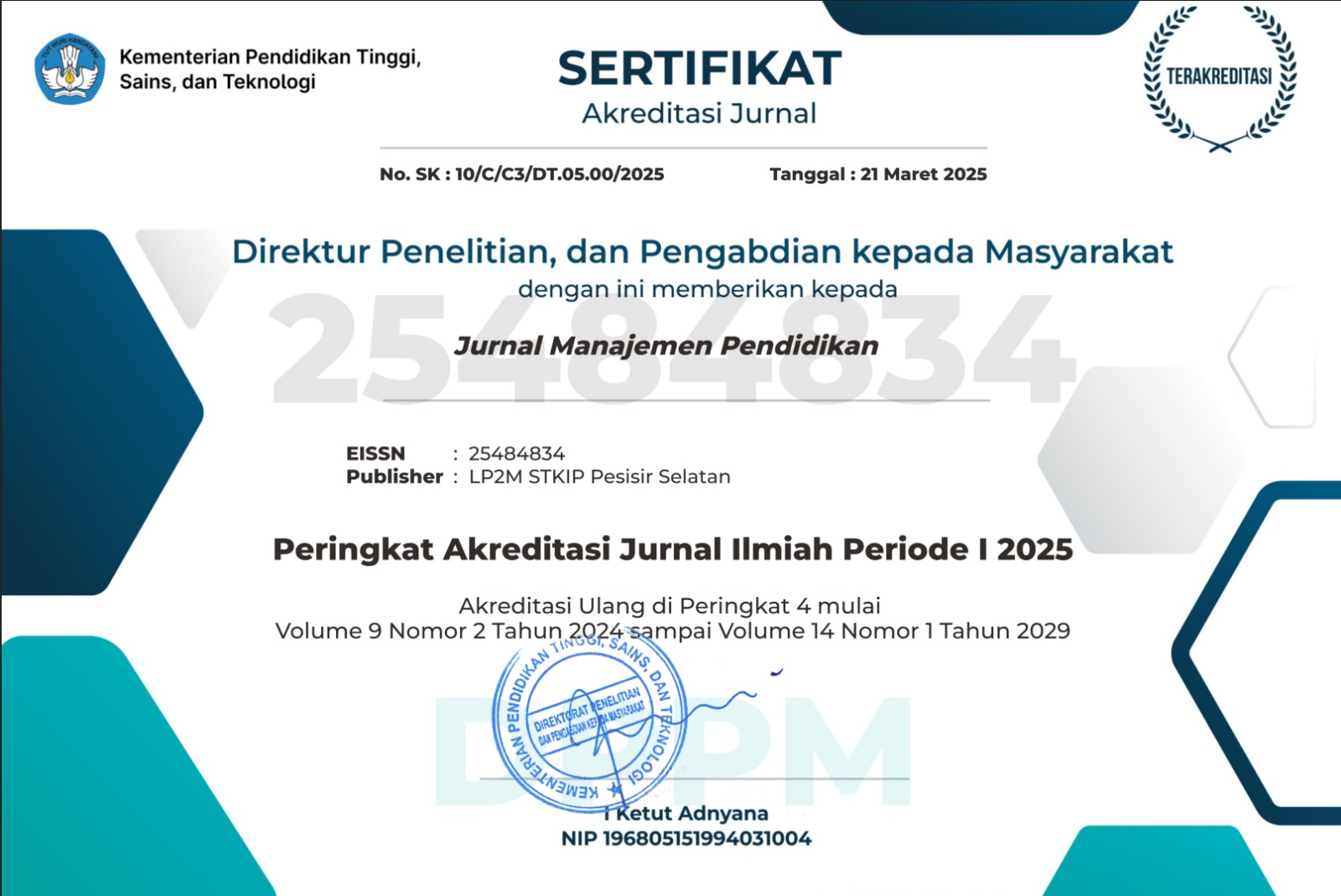
KEMANDIRIAN EKONOMI LEMBAGA PENDIDIKAN ISLAM MELALUI SOCIAL ENTREPRENEURSHIP
DOI:
https://doi.org/10.34125/jmp.v11i3.2578Keywords:
Economic independence, Islamic education institution, Social entrepreneurship, Sustainable financing, Institutional governanceAbstract
This study aims to formulate a conceptual model of institutional economic independence through social entrepreneurship in Islamic educational institutions. The issue is important because many educational institutions depend on tuition, donations, and unstable external support, while social expectations toward access, quality, and community empowerment continue to increase. Methods: This article uses an integrative literature review by synthesizing studies on social entrepreneurship, hybrid organization, nonprofit finance, pesantren business units, cooperative governance, and sustainable institutional management. The analysis was conducted through thematic coding, conceptual comparison, and model construction. Results: The study identifies five interrelated elements of economic independence: asset mapping, social value proposition, diversified income portfolio, hybrid governance, and impact-based reinvestment. Social entrepreneurship enables institutions to generate revenue without abandoning their educational and social missions, provided that accountability, transparency, mission protection, and stakeholder participation are institutionalized. Novelty: The article offers an institutional economic independence model that integrates global social entrepreneurship theory with the Indonesian Islamic education context. The proposed model positions business activities not as commercial deviation, but as a mission-driven strategy to strengthen educational sustainability, social impact, and community welfare.
References
Afandi, Z. (2019). Strategi pendidikan entrepreneurship di pesantren Al-Mawaddah Kudus. Bisnis: Jurnal Bisnis dan Manajemen Islam, 7(1), 55–68. https://doi.org/10.21043/bisnis.v7i1.5191
Annisa, A. A. (2021). Determining model of halal lifestyle: A study on the role of Kopontren. Equilibrium: Jurnal Ekonomi Syariah, 9(1), 153–176. https://doi.org/10.21043/equilibrium.v9i1.10458
Austin, J., Stevenson, H., & Wei-Skillern, J. (2006). Social and commercial entrepreneurship: Same, different, or both? Entrepreneurship Theory and Practice, 30(1), 1–22. https://doi.org/10.1111/j.1540-6520.2006.00107.x
Battilana, J., & Lee, M. (2014). Advancing research on hybrid organizing: Insights from the study of social enterprises. Academy of Management Annals, 8(1), 397–441. https://doi.org/10.5465/19416520.2014.893615
Besharov, M. L., & Smith, W. K. (2014). Multiple institutional logics in organizations: Explaining their varied nature and implications. Academy of Management Review, 39(3), 364–381. https://doi.org/10.5465/amr.2011.0431
Bornstein, D., & Davis, S. (2010). Social entrepreneurship: What everyone needs to know. Oxford University Press. https://global.oup.com/academic/product/social-entrepreneurship-9780195396331
Cahyo, D. I. (2021). Etika bisnis unit usaha pesantren: Studi kasus Pondok Pesantren Sahid Bogor dan Pondok Pesantren Ummul Qura Al-Islami Bogor. SALAM: Jurnal Sosial dan Budaya Syar-i, 8(1), 1–20. https://doi.org/10.15408/sjsbs.v8i1.19383
Cornforth, C. (2014). Understanding and combating mission drift in social enterprises. Social Enterprise Journal, 10(1), 3–20. https://doi.org/10.1108/SEJ-09-2013-0036
Dacin, P. A., Dacin, M. T., & Matear, M. (2010). Social entrepreneurship: Why we do not need a new theory and how we move forward from here. Academy of Management Perspectives, 24(3), 37–57. https://doi.org/10.5465/amp.24.3.37
Dees, J. G., Emerson, J., & Economy, P. (2001). Enterprising nonprofits: A toolkit for social entrepreneurs. John Wiley & Sons. https://www.wiley.com/en-us/Enterprising+Nonprofits%3A+A+Toolkit+for+Social+Entrepreneurs-p-9780471151166
Defourny, J., & Nyssens, M. (2010). Conceptions of social enterprise and social entrepreneurship in Europe and the United States: Convergences and divergences. Journal of Social Entrepreneurship, 1(1), 32–53. https://doi.org/10.1080/19420670903442053
Desa, G., & Basu, S. (2013). Optimization or bricolage? Overcoming resource constraints in global social entrepreneurship. Strategic Entrepreneurship Journal, 7(1), 26–49. https://doi.org/10.1002/sej.1150
Doherty, B., Haugh, H., & Lyon, F. (2014). Social enterprises as hybrid organizations: A review and research agenda. International Journal of Management Reviews, 16(4), 417–436. https://doi.org/10.1111/ijmr.12028
Drucker, P. F. (1990). Managing the nonprofit organization: Principles and practices. HarperCollins. https://www.harpercollins.com/products/managing-the-non-profit-organization-peter-f-drucker
Ebrahim, A., Battilana, J., & Mair, J. (2014). The governance of social enterprises: Mission drift and accountability challenges in hybrid organizations. California Management Review, 56(3), 81–100. https://doi.org/10.1525/cmr.2014.56.3.81
European Commission & OECD. (2016). Policy brief on scaling the impact of social enterprises: Policies for social entrepreneurship. OECD Publishing. https://www.oecd.org/cfe/leed/Policy-brief-Scaling-up-social-enterprises-EN.pdf
Fahmi, Z., Seprina, E., Aryuli, K., Friyatmi, F., & Evanita, S. (2022). Social entrepreneurship: Wujud kemaslahatan umat melalui program kewirausahaan santri sebagai upaya membangun generasi robbani. Jurnal Ilmiah Ekonomi Islam, 8(3), 3224–3230. https://doi.org/10.29040/jiei.v8i3.6335
Falach, A. N., Ridwan, M., & Zenrif, M. F. (2023). Santripreneurship in practice: A model of entrepreneurship development at Sunan Drajat Islamic Boarding School, Lamongan. Economica: Jurnal Ekonomi Islam, 14(2), 265–292. https://doi.org/10.21580/economica.2023.14.2.26006
Fowler, A. (2000). The virtuous spiral: A guide to sustainability for NGOs in international development. Earthscan. https://www.routledge.com/The-Virtuous-Spiral-A-Guide-to-Sustainability-for-NGOs-in-International-Development/Fowler/p/book/9781853836167
Gras, D., & Mendoza-Abarca, K. I. (2014). Risky business? The survival implications of exploiting commercial opportunities by nonprofits. Journal of Business Venturing, 29(3), 392–404. https://doi.org/10.1016/j.jbusvent.2013.05.003
Gupta, P., Chauhan, S., Paul, J., & Jaiswal, M. P. (2020). Social entrepreneurship research: A review and future research agenda. Journal of Business Research, 113, 209–229. https://doi.org/10.1016/j.jbusres.2020.03.032
Haugh, H. (2007). Community-led social venture creation. Entrepreneurship Theory and Practice, 31(2), 161–182. https://doi.org/10.1111/j.1540-6520.2007.00168.x
Hlady-Rispal, M., & Servantie, V. (2018). Deconstructing the way in which value is created in the context of social entrepreneurship. International Journal of Management Reviews, 20(1), 62–80. https://doi.org/10.1111/ijmr.12113
Humaidi, A. (2021). Pesantren business entity development as an education basis for the autonomy of santri, pesantren, and the community: A case study at Pesantren Sidogiri Pasuruan. Didaktika Religia, 9(1), 121–144. https://doi.org/10.30762/didaktika.v9i1.1937
Indarti, L. (2021). Menggali penerapan kewirausahaan di pondok pesantren. Tadbir: Jurnal Manajemen Pendidikan Islam, 9(2), 241–252. https://doi.org/10.30603/tjmpi.v9i2.2276
Kannampuzha, M. J., & Hockerts, K. (2019). Organizational social entrepreneurship: Scale development and validation. Social Enterprise Journal, 15(3), 290–319. https://doi.org/10.1108/SEJ-06-2018-0047
Littlewood, D., & Holt, D. (2018). Social entrepreneurship in South Africa: Exploring the influence of environment. Business & Society, 57(3), 525–561. https://doi.org/10.1177/0007650315613293
Lumpkin, G. T., Moss, T. W., Gras, D. M., Kato, S., & Amezcua, A. S. (2013). Entrepreneurial processes in social contexts: How are they different, if at all? Entrepreneurship Theory and Practice, 37(3), 761–783. https://doi.org/10.1111/j.1540-6520.2012.00556.x
Mair, J., & Martí, I. (2006). Social entrepreneurship research: A source of explanation, prediction, and delight. Journal of World Business, 41(1), 36–44. https://doi.org/10.1016/j.jwb.2005.09.002
Mair, J., Mayer, J., & Lutz, E. (2015). Navigating institutional plurality: Organizational governance in hybrid organizations. Organization Studies, 36(6), 713–739. https://doi.org/10.1177/0170840615580007
Moss, T. W., Short, J. C., Payne, G. T., & Lumpkin, G. T. (2011). Dual identities in social ventures: An exploratory study. Entrepreneurship Theory and Practice, 35(5), 805–830. https://doi.org/10.1111/j.1540-6520.2010.00372.x
Nicholls, A. (Ed.). (2006). Social entrepreneurship: New models of sustainable social change. Oxford University Press. https://global.oup.com/academic/product/social-entrepreneurship-9780199283873
OECD & European Commission. (2013). Policy brief on social entrepreneurship: Entrepreneurial activities in Europe. OECD Publishing. https://www.oecd.org/cfe/leed/Social%20entrepreneurship%20policy%20brief%20EN_FINAL.pdf
Osterwalder, A., & Pigneur, Y. (2010). Business model generation: A handbook for visionaries, game changers, and challengers. John Wiley & Sons. https://www.wiley.com/en-us/Business+Model+Generation-p-9780470876411
Pache, A. C., & Santos, F. (2013). Inside the hybrid organization: Selective coupling as a response to competing institutional logics. Academy of Management Journal, 56(4), 972–1001. https://doi.org/10.5465/amj.2011.0405
Pratiwi, R., Wardhani, W. N. R., Prabowo, M. S., Amaniyah, F., & Rohim, F. (2022). Pemberdayaan santripreneur di pesantren: Kajian kepemimpinan perempuan nyai dalam meningkatkan keterlibatan santriwati dalam berwirausaha. Iqtishaduna: Jurnal Ilmiah Mahasiswa Hukum Ekonomi Syariah, 8(2), 98–110. https://doi.org/10.24252/iqtisaduna.v8i2.31321
Rohima, Y. K. I., Sabarudin, M., Rahmat, R., Wulan, S., & Badrudin, B. (2024). Entrepreneurship-based financing strategy towards pesantren independence. Ta’dib: Jurnal Pendidikan Islam, 29(2), 210–225. https://doi.org/10.19109/td.v29i2.25189
Saebi, T., Foss, N. J., & Linder, S. (2019). Social entrepreneurship research: Past achievements and future promises. Journal of Management, 45(1), 70–95. https://doi.org/10.1177/0149206318793196
Santos, F. M. (2012). A positive theory of social entrepreneurship. Journal of Business Venturing, 27(3), 335–351. https://doi.org/10.1016/j.jbusvent.2010.11.007
Shepherd, D. A., & Patzelt, H. (2011). The new field of sustainable entrepreneurship: Studying entrepreneurial action linking what is to be sustained with what is to be developed. Entrepreneurship Theory and Practice, 35(1), 137–163. https://doi.org/10.1111/j.1540-6520.2010.00426.x
Short, J. C., Moss, T. W., & Lumpkin, G. T. (2009). Research in social entrepreneurship: Past contributions and future opportunities. Strategic Entrepreneurship Journal, 3(2), 161–194. https://doi.org/10.1002/sej.69
Siregar, R. A. S., Rababah, M. A., Ritonga, R., Harahap, T. M., & Siregar, E. (2025). Islamic boarding school cooperatives as an instrument for empowering the community’s economy: Analysis of Islamic economic law. Nurani: Jurnal Kajian Syari’ah dan Masyarakat, 25(1), 323–343. https://doi.org/10.19109/nurani.v25i1.27698
Smith, W. K., Gonin, M., & Besharov, M. L. (2013). Managing social-business tensions: A review and research agenda for social enterprise. Business Ethics Quarterly, 23(3), 407–442. https://doi.org/10.5840/beq201323327
Stephan, U., Uhlaner, L. M., & Stride, C. (2015). Institutions and social entrepreneurship: The role of institutional voids, institutional support, and institutional configurations. Journal of International Business Studies, 46(3), 308–331. https://doi.org/10.1057/jibs.2014.38
Tracey, P., & Phillips, N. (2016). Managing the consequences of organizational stigmatization: Identity work in a social enterprise. Academy of Management Journal, 59(3), 740–765. https://doi.org/10.5465/amj.2013.0483
Weerawardena, J., & Mort, G. S. (2006). Investigating social entrepreneurship: A multidimensional model. Journal of World Business, 41(1), 21–35. https://doi.org/10.1016/j.jwb.2005.09.001
Wry, T., & York, J. G. (2017). An identity-based approach to social enterprise. Academy of Management Review, 42(3), 437–460. https://doi.org/10.5465/amr.2013.0506
Young, D. R. (2007). Financing nonprofits: Putting theory into practice. AltaMira Press. https://rowman.com/ISBN/9780759109889/Financing-Nonprofits-Putting-Theory-into-Practice
Yunus, M. (2007). Creating a world without poverty: Social business and the future of capitalism. PublicAffairs. https://www.publicaffairsbooks.com/titles/muhammad-yunus/creating-a-world-without-poverty/9781586486679/
Yunus, M., Moingeon, B., & Lehmann-Ortega, L. (2010). Building social business models: Lessons from the Grameen experience. Long Range Planning, 43(2–3), 308–325. https://doi.org/10.1016/j.lrp.2009.12.005