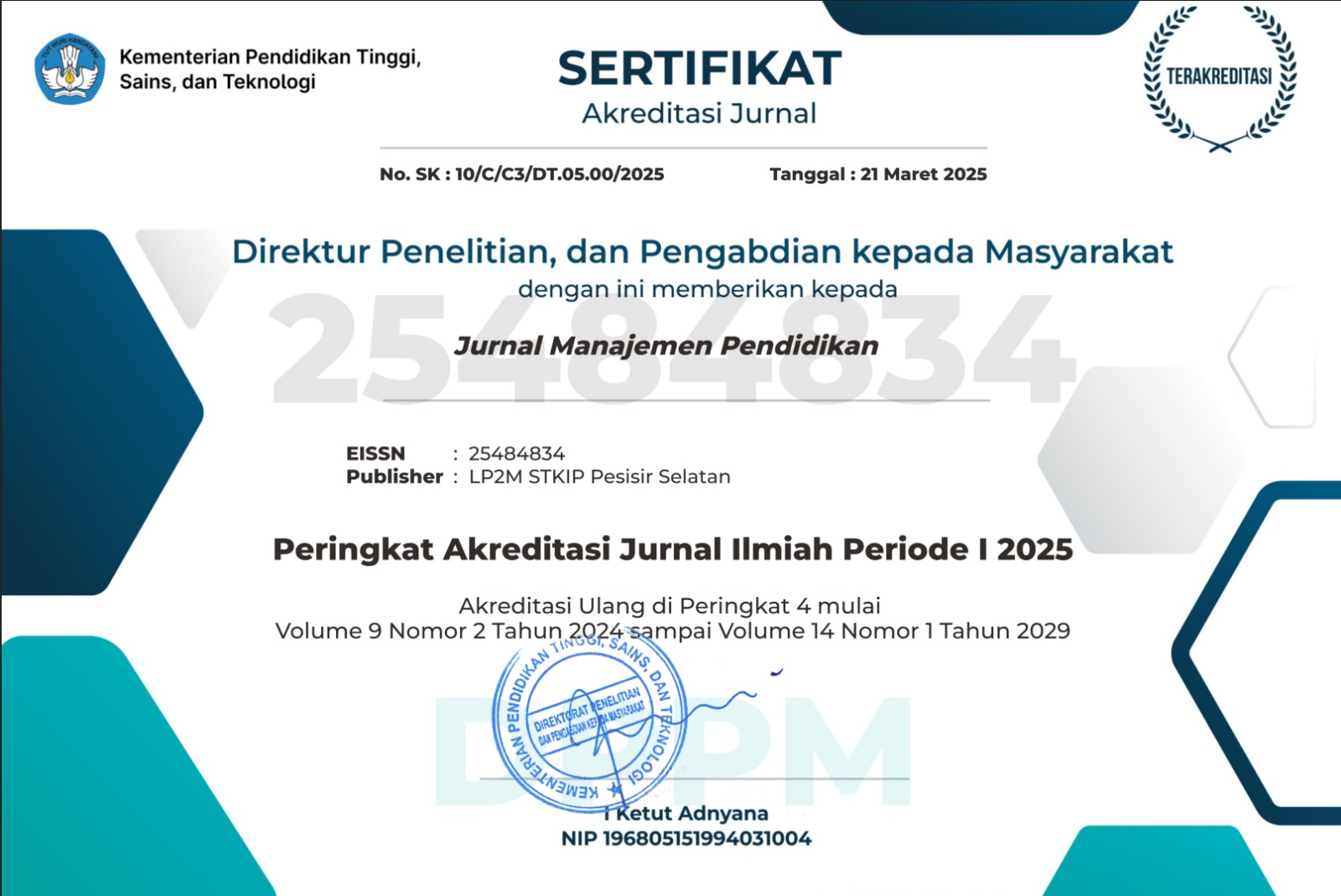
PENGARUH SELF-EFFICACY TERHADAP KESIAPAN KERJA MELALUI EMPLOYABILITY SKILLS PADA SISWA KELAS XII SMK NEGERI 4 KOTA JAMBI PASCA PKL
DOI:
https://doi.org/10.34125/jmp.v11i4.3124Keywords:
self-efficacy, employability skills, kesiapan kerja, siswa SMKAbstract
Work readiness has become an important issue in vocational education, as vocational high school graduates are expected not only to master technical competencies but also to possess self-confidence and work-related skills that support their adaptation to the workplace. This study aimed to examine the effect of self-efficacy on the work readiness of twelfth-grade students at SMK Negeri 4 Kota Jambi, both directly and indirectly through employability skills as a mediating variable. A quantitative explanatory design was employed involving 346 respondents out of 423 students who had completed industrial work practice, with data analyzed using partial least squares structural equation modeling (PLS-SEM). The findings revealed that self-efficacy had a positive and significant effect on work readiness and employability skills, while employability skills also had a positive and significant effect on work readiness and partially mediated the relationship between self-efficacy and work readiness. The novelty of this study lies in highlighting the mediating role of employability skills in explaining how self-efficacy contributes to the work readiness of vocational high school students after industrial work practice.
References
Attin, L. B., Miranti, M. G., Pangesthi, G. T., & Dewi, I. H. (2024). Hubungan Self efficacy Terhadap Employability skills Pada Siswa Kelas XII Culinary di SMK N 8 Surabaya. JVTE: Journal of Vocational and Technical Education, 6(1), 66 - 74. doi:https://doi.org/10.26740/jvte.v6n1.p66-75
Badan Pusat Statistik Provinsi Jambi. (2025, November 5). Tingkat Pengangguran Terbuka (TPT) Agustus 2025 sebesar 4,26 persen. Dipetik November 15, 2025, dari https://jambi.bps.go.id/id/pressrelease/2025/11/05/810/tingkat-pengangguran-terbuka--tpt--agustus-2025-sebesar-4-26-persen.html
Bandura, A. (1997). Self-efficacy: The exercise of control. New York: W. H. Freeman and Company.
Caballero, C. L., & Walker, A. (2010). Work readiness in graduate recruitment and selection: A review of current assessment methods. Journal of Teaching and Learning for Graduate Employability, 1(1), 13-25.
Caballero, C. L., Walker, A., & Tyszkiewicz, M. F. (2011). The Work Readiness Scale (WRS): Developing a measure to assess work readiness in college graduates. Journal of Teaching and Learning for Graduate Employability, 2(2), 41-54.
Fitri, S. S., & Wulandari, R. N. (2025). Pengaruh Kecerdasan Emosional dan Self-efficacy Terhadap Employability skills Mahasiswa Pendidikan Administrasi Perkantoran Universitas Negeri Surabaya. Jurnal Ilmiah Profesi Pendidikan, 10(4), 3074 -3080. doi:https://doi.org/10.29303/jipp.v10i4.3924
Habibah, I. F., & Dwijayanti, R. (2023). Pengaruh Praktik Kerja Lapangan (PKL), Self-efficacy, dan Internal Locus Of Control Terhadap Kesiapan Kerja Siswa SMKN Mojoagung Jombang. Jurnal Pendidikan Tata Niaga (JPTN), 11(2), 142-151. doi:https://doi.org/10.26740/jptn.v11n2.p142-152
Hair, J. F., Hult, G. T., Ringle, C. M., Sarstedt, M., Danks, N. P., & Ray, S. (2021). Partial Least Squares Structural Equation Modeling (PLS-SEM) Using R. Switzerland: Springer.
Hayati, A. N., Ninghardjanti, P., & Susantiningrum, S. (2024). Pengaruh Pengalaman Praktik Kerja Lapangan (PKL) Dan Employability skills Terhadap Kesiapan Kerja Siswa SMK Negeri 1 Banyudono. Journal of Creative Student Research (JCSR), 2(3), 67-86. doi:https://doi.org/10.55606/jcsrpolitama.v2i3.3833
Hepriyadi, F. A., & Pahlevi, T. (2026). Pengaruh Self Efficacy, Adversity Quotient, dan Dukungan Sosial terhadap Kesiapan Kerja Siswa dengan Kompetensi Keahlian Manajemen Perkantoran di SMK PGRI 13 Surabaya. JIIP (Jurnal Ilmiah Ilmu Pendidikan), 9(6), 1803-1811. doi:https://doi.org/10.54371/jiip.v9i2.10721
Hidayanti, N. (2023). Implikasi Self Efficacy Albert Bandura dalam Pendidikan Agama Islam. Risalah: Jurnal Pendidikan dan Studi Islam, 9(4), 1626 - 1636. doi:https://doi.org/10.31943/jurnal_risalah.v9i4.618
Kementrian Pendidikan dan Kebudayaan. (2020). Peraturan Menteri Pendidikan dan Kebudayaan Republik Indonesia Nomor 50 Tahun 2020 Tentang Praktik Kerja Lapangan Bagi Peserta Didik. Dipetik Oktober 11, 2025, dari https://peraturan.bpk.go.id/Details/163849/permendikbud-no-50-tahun-2020
Khotimah, I., & Wiyono, D. (2022). Pengaruh Employability Skill Terhadap Kesiapan Kerja LPP Ariyanti. Indonesian Journal of Office Administration Adminof, IV(1), 124-133. Diambil kembali dari https://www.adminof.ariyanti.ac.id/index.php/adminof/article/view/53
Mulyani, S., Tazqiloh, A. Z., & Ekawaty, N. (2025). Pengaruh Praktik Kerja Industri dan Self EfficacyTerhadap Kesiapan Kerja (Studi Kasus pada Lulusan Tahun 2023 dan 2024 di SMK Negeri 1 Cikampek). INNOVATIVE: Journal Of Social Science Research, 5(3), 6289-6302. doi:https://doi.org/10.31004/innovative.v5i3.19608
Muspawi, M., & Lestari, A. (2020). Membangun Kesiapan Kerja Calon Tenaga Kerja. Jurnal Literasiologi, 4(1), 111 - 117. doi:https://doi.org/10.47783/literasiologi.v4i1.138
Paramitha, N. A., & Harmanto. (2024). Pengaruh Perencanaan Karir Dan Employability skills Terhadap Kesiapan Kerja Peserta Didik Kelas XII Jurusan Akuntansi Dan Keuangan Lembaga SMKN Kasiman. Syntax Literate: Jurnal Ilmiah Indonesia, 9(9), 4792-4802. doi:https://doi.org/10.36418/syntax-literate.v9i9.16332
Pemerintah Indonesia. (2010). Peraturan Pemerintah Nomor 17 Tahun 2010 tentang Pengelolaan dan Penyelenggaraan Pendidikan. Dipetik Februari 09, 2025, dari https://peraturan.bpk.go.id/Details/5025/pp-no-17-tahun-2010
Purnama, S. I., Indrawati, C. D., & Akbarini, N. R. (2024). Pengaruh digital literacy dan self efficacy terhadap kesiapan . Jurnal Informasi dan Komunikasi Administrasi Perkantoran kerja siswa SMK Negeri 1 Sukoharjo, 8(1), 65 - 72. doi:https://dx.doi.org/10.20961/jikap.v8i1.75699
Saulatu, R. H., Kempa, R., & Lekatompessy, J. E. (2025). Pengaruh Employability skills dan Self-efficacy terhadap Kesiapan Kerja Siswa SMK Negeri 3 Ambon. JIIP: Jurnal Ilmiah Ilmu Pendidikan, 8(6), 5696-5705. doi:https://doi.org/10.54371/jiip.v8i6.8028
SCANS. (1991). What work requires of schools: A SCANS report for America 2000. Washington DC: U.S. Department of Labor.
Septiana, R. (2025). Pengaruh Pengalaman Praktik Kerja Lapangan, Motivasi Memasuki Dunia Kerja, dan Employability skills Terhadap Kesiapan Kerja Siswa Kelas XII MPLB SMKN 1 Karanganyar. PENG: Jurnal Ekonomi Dan Manajemen, 3(1), 899-905. doi:https://doi.org/10.62710/vyy76503
Sugeng, B. (2020). Fundamental Metodologi Penelitian Kuantitatif (Eksplanatif). Yogyakarta: Deepublish.
Sugiyono. (2023). Metode Penelitian Kuantitatif, Kualitatif, dan R&D. Bandung: Alfabeta.
Suyitno, S., Nurtanto, M., Jatmoko, D., & dkk. (2025). The Effect of Work-Based Learning on Employability Skills: The Role of Self-efficacy and Vocational Identity. European Journal of Educational Research, 14(1), 309 - 321. doi:https://doi.org/10.12973/eu-jer.14.1.309
Thapa, H. S. (2024). Development of Employability skills through Work-Based. Journal of Technical and Vocational Education and Training (TVET), 18(1), 102-111.
Urrofik, S. A., Arbarini, M., Suminar, T., & Cahyani, A. D. (2025). Competency-Based Training and Self-efficacy on Work Readiness Through Employability skills in The Center for Vocational Training and Productivity and Productivity. Jurnal Imiah Pendidikan dan Pembelajaran, 9(1), 129-140. doi:https://doi.org/10.23887/jipp.v9i1.86823