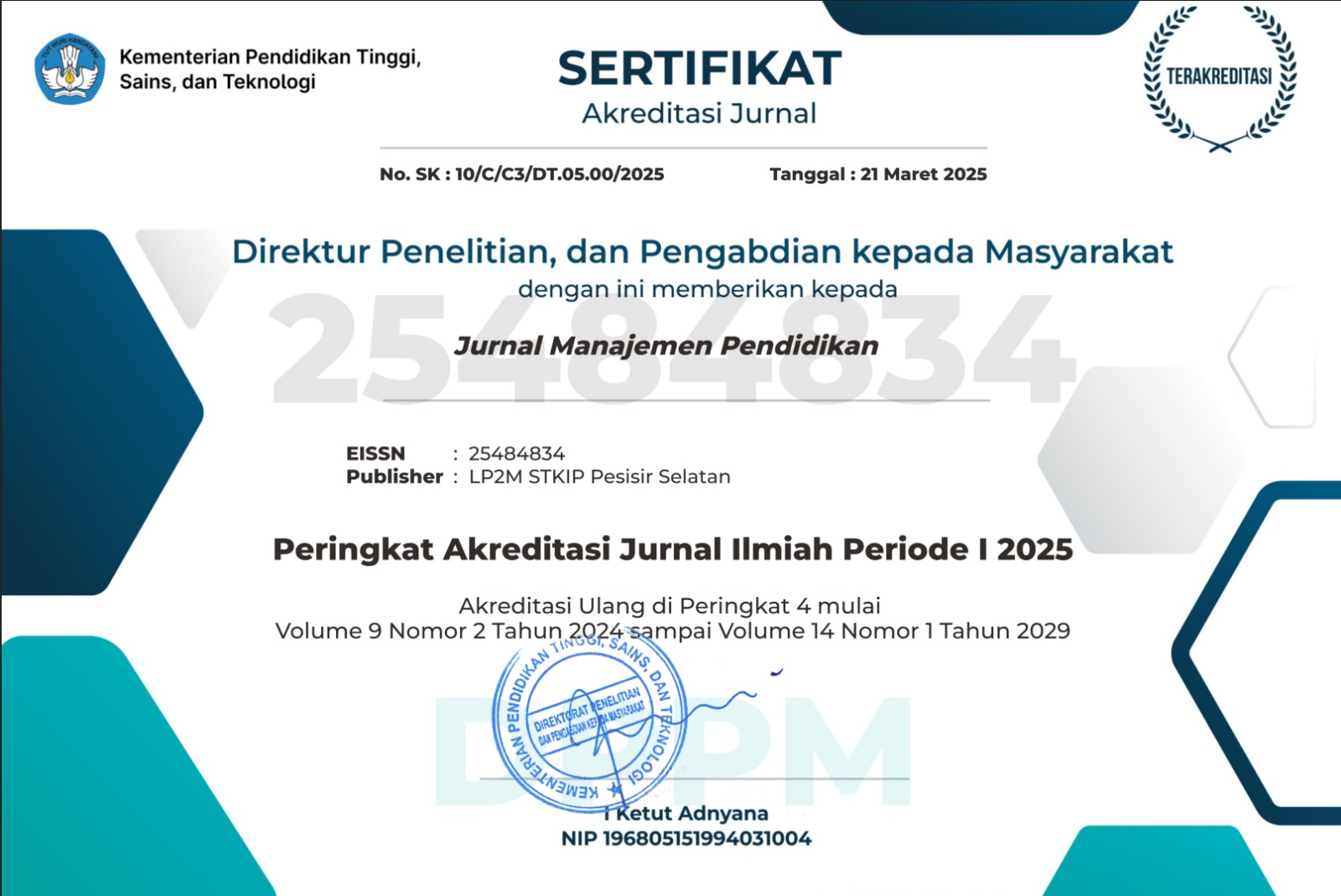
DINAMIKA DAN TANTANGAN TENAGA PENDIDIK SERTA KEPENDIDIKAN PADA ERA ARTIFICIAL INTELLIGENCE DALAM PENDIDIKAN PESANTREN
DOI:
https://doi.org/10.34125/jmp.v11i4.3387Keywords:
Artificial Intelligence Pendidikan, Tenaga Pendidik dan Kependidikan, Pendidikan Pesantren DigitalAbstract
This article aims to analyze the dynamics and challenges faced by teaching and educational support staff in responding to the development of Artificial Intelligence (AI) within the pesantren education system, as well as to identify adaptive strategies for improving technology-based educational management. This study employed a descriptive qualitative approach using literature review and contextual observation methods to examine the implementation of digital technology in modern pesantren. Research data were collected from scientific journals, educational documents, digital transformation policies, and empirical phenomena related to the use of AI in educational administration and learning activities. Data analysis was conducted using the interactive model, while data validity was ensured through triangulation techniques. The findings reveal that AI development has significantly influenced the working patterns of teaching and educational personnel, particularly in academic administration, data management, learning effectiveness, and the innovation of digital learning media. However, limited technological competence, low digital literacy, organizational cultural resistance, and inadequate professional training remain major challenges. This study contributes to strengthening the concept of adaptive, innovative, and value-based human resource development in pesantren education to address the challenges of technological disruption in the digital era.
References
Abduh, A., Achmad, S. F., Syam, C., Samad, S., Arham, M., Mustafa, M., & Pandang, A. (2026). Dataset on the number of schools, teachers, and students in Sulawesi, Indonesia: kindergarten, primary, junior, senior high, vocational, and Islamic boarding schools with educational access, quality, and cultural implications to solve challenges and strategies in education management and support Sustainable Development Goals (SDGs). ASEAN Journal of Educational Research and Technology, 5(1), 89–116.
Adedoyin, O. B., & Soykan, E. (2023). Covid-19 pandemic and online learning: the challenges and opportunities. Interactive Learning Environments, 31(2), 863–875.
Adel, A. (2024). The convergence of intelligent tutoring, robotics, and IoT in smart education for the transition from industry 4.0 to 5.0. Smart Cities, 7(1), 325–369.
Ahmad, M. M., & Nusrat, R. (2026). Religious education sectors for women in Bangladesh: an assessment on teaching quality, learning, and employability. Development in Practice, 1–14.
Ahmad, S. F., Alam, M. M., Rahmat, M. K., Mubarik, M. S., & Hyder, S. I. (2022). Academic and administrative role of artificial intelligence in education. Sustainability, 14(3), 1101.
Ahmed, V., & Opoku, A. (2022). Technology supported learning and pedagogy in times of crisis: the case of COVID-19 pandemic. Education and Information Technologies, 27(1), 365–405.
AlAfnan, M. A., Dishari, S., Jovic, M., & Lomidze, K. (2023). Chatgpt as an educational tool: Opportunities, challenges, and recommendations for communication, business writing, and composition courses. Journal of Artificial Intelligence and Technology, 3(2), 60–68.
Alarfaj, A., & Alrashidi, M. (2025). Revolutionizing gifted education: enhancing teachers’ digital competence through fourth industrial revolution training. Discover Sustainability, 6(1), 159.
Alenezi, M., Wardat, S., & Akour, M. (2023). The need of integrating digital education in higher education: Challenges and opportunities. Sustainability, 15(6), 4782.
Almuhanna, M. A. (2025). Teachers’ perspectives of integrating AI-powered technologies in K-12 education for creating customized learning materials and resources. Education and Information Technologies, 30(8), 10343–10371.
Arif, M., & Maryani, E. (2023). Analysis of Environmental Literacy Profile Indonesian Students at STKIP Pesisir Selatan, West Sumatera. Jurnal Geografi, 15(2), 259–271.
Arif, M., & Syaflita, D. (2021). Persepsi Mahasiswa terhadap Pelaksanaan Pembelajaran Daring pada Masa Pandemi Covid-19 di STKIP Pesisir Selatan. Sosio-Didaktika: Social Science Education Journal, 8(1).
Bonales-Daimie, G., Martínez-Estrella, E., & Sierra-Sánchez, J. (2025). Evolution of the Teaching Profile and the Emergence of New Professional Roles in the Age of Artificial Intelligence (AI). A Perspective from Teachers, Students and Professionals. Pixel-Bit, Revista de Medios y Educacion, (73).
Darwanto, A., Prahmana, R. C. I., Susanti, A., & Khalil, I. A. (2024). Transformation of boarding school management models in enhancing student accessibility and educational quality. Jurnal Pendidikan Agama Islam, 21(1), 145–164.
Duan, H., & Zhao, W. (2024). The effects of educational artificial intelligence-powered applications on teachers’ perceived autonomy, professional development for online teaching, and digital burnout. International Review of Research in Open and Distributed Learning, 25(3), 57–76.
Elmahjub, E. (2023). Artificial Intelligence (AI) in Islamic Ethics: Towards Pluralist Ethical Benchmarking for AI: E. Elmahjub. Philosophy & Technology, 36(4), 73.
Faizin, N., Alfan, M., Basid, A., Ramadhan, M. R., Panatik, S. A., & Kawakip, A. N. (2025). Muslim students’ acceptance of artificial intelligence in Islamic religious education: an extended TAM approach. Discover Education, 4(1), 304.
Fajar, A. S. M., Fauzi, A., Darmawan, D., Putra, A. R., & Arifin, S. (2025). Transformation of Islamic Religious Education in the Digital Landscape and its Implications for Pedagogical Innovation. International Journal of Service Science, Management, Engineering, and Technology, 8(1), 15–20.
Ghashim, I. A., & Arshad, M. (2023). Internet of things (IoT)-based teaching and learning: modern trends and open challenges. Sustainability, 15(21), 15656.
Hanafi, Y., Taufiq, A., Saefi, M., Ikhsan, M. A., Diyana, T. N., Thoriquttyas, T., & Anam, F. K. (2021). The new identity of Indonesian Islamic boarding schools in the “new normal”: the education leadership response to COVID-19. Heliyon, 7(3).
Hastasari, C., Setiawan, B., & Aw, S. (2022). Students’ communication patterns of islamic boarding schools: the case of Students in Muallimin Muhammadiyah Yogyakarta. Heliyon, 8(1).
Henadirage, A., Chathuranga, B. T. K., & Gunarathne, N. (2026). Changing assessment landscape in management education with AI-driven technologies: impacts and drivers. International Journal of Educational Technology in Higher Education, 23(1), 4.
Islamic, G., Ishaq, M., & Dayati, U. (2024). Character education through philosophical values in traditional Islamic boarding schools. Kasetsart Journal of Social Sciences, 45(1), 31–42.
Jamil, Z. A., Ulfah, S. M., & Youssef, A. (2025). Program evaluation study on Islamic religious education in pesantren: Addressing educational degradation in the digital era. Jurnal Pendidikan Agama Islam, 22(1), 122–139.
Jita, T., & Dhliwayo, A. (2024). Design-Based Approach to Technology Innovation: Teacher Educators’ Experiences with Tablets as Instructional Tools in South Africa. Contemporary Educational Technology, 16(3).
Jubba, H., Pabbajah, M., Abdullah, I., & Juhansar, J. (2022). Reorienting Moral Education for Millennial Muslims: The Changing Role of Islamic Boarding Schools in Indonesia. The Islamic Quarterly, 65(10), 123–129.
Katsamakas, E., Pavlov, O. V, & Saklad, R. (2024). Artificial intelligence and the transformation of higher education institutions: A systems approach. Sustainability, 16(14), 6118.
Khairullah, S. A., Harris, S., Hadi, H. J., Sandhu, R. A., Ahmad, N., & Alshara, M. A. (2025). Implementing artificial intelligence in academic and administrative processes through responsible strategic leadership in the higher education institutions. Frontiers in Education, 10, 1548104. Frontiers Media SA.
Kosim, M., Muqoddam, F., Mubarok, F., & Laila, N. Q. (2023). The dynamics of Islamic education policies in Indonesia. Cogent Education, 10(1), 2172930.
Mahade, A., Elmahi, A., Alomari, K. M., & Abdalla, A. A. (2025). Leveraging AI-driven insights to enhance sustainable human resource management performance: moderated mediation model: evidence from UAE higher education. Discover Sustainability, 6(1), 267.
Mariyono, D. (2025). Forming multicultural entrepreneurs attitudes (MEA): insights from Islamic boarding school. The Bottom Line.
Mu’alimin, M., Muhith, A. M., & Hepni, H. (2026). School principals’ and teachers’ perspectives on school quality management in Islamic schools: insights from Indonesia. International Journal of Educational Management, 40(4), 727–741.
Muhith, A., Dwiyono, Y., Munawati, S., Mustofa, A., & Haryanto, S. (2023). Challenges of islamic boarding school organizational culture in the millennial generation and the digital era 4.0. Nazhruna: Jurnal Pendidikan Islam, 6(3), 457–474.
Mutambik, I. (2024). The use of AI-driven automation to enhance student learning experiences in the KSA: An alternative pathway to sustainable education. Sustainability, 16(14), 5970.
Nagy, M., Lăzăroiu, G., & Valaskova, K. (2023). Machine intelligence and autonomous robotic technologies in the corporate context of SMEs: Deep learning and virtual simulation algorithms, cyber-physical production networks, and Industry 4.0-based manufacturing systems. Applied Sciences, 13(3), 1681.
Nata, A., Rosyada, D., Rahiem, M. D. H., & Ugli, A. R. R. (2024). Digital extension of digital literacy competence for islamic religious education teachers in the era of digital learning. Jurnal Pendidikan Agama Islam, 21(2), 402–420.
Nazari, Z., Vahidi, A. R., & Musilek, P. (2024). Blockchain and artificial intelligence non-formal education system (BANFES). Education Sciences, 14(8), 881.
Nurlela, N., Arifin, A. G., & Hidayat, A. (2025). Impact of Islamic psychoeducation in facing the challenges of digital education practices: Student and lecturer perceptions. International Journal of Learning, Teaching and Educational Research, 24(2), 560–585.
Rensfeldt, A. B., & Rahm, L. (2023). Automating teacher work? A history of the politics of automation and artificial intelligence in education. Postdigital Science and Education, 5(1), 25–43.
Rochim, A. A., & Khayati, A. (2022). Role of Islamic Education Teachers in Shaping Students’ Religious Character in the Digital Era: A Case Study of SDN 1 Kondangsari, Cirebon. International Journal of Educational Development, 89(102534), 2023–2032.
Rohman, A., Mudis Taruna, M., Wahab, Mustolehudin, & Mintarti. (2025). Islamic boarding school policy in response to the transmission of transnational religious ideologies in Klaten, Indonesia. Cogent Education, 12(1), 2436291.
Rusli, R., & Nurdin, N. (2022). Understanding Indonesia millennia Ulama online knowledge acquisition and use in daily fatwa making habits. Education and Information Technologies, 27(3), 4117–4140.
Saif, S. M., Ansarullah, S. I., Ben Othman, M. T., Alshmrany, S., Shafiq, M., & Hamam, H. (2022). Impact of ICT in modernizing the global education industry to yield better academic outreach. Sustainability, 14(11), 6884.
Samadhiya, A., Kumar, A., Mulat-Weldemeskel, E., Luthra, S., Garza-Reyes, J. A., & Yadav, S. (2026). Next-gen quality learning: How can AI technologies shape education 4.0 and 5.0 towards the SDGs from multiple stakeholders’ perspective? The TQM Journal, 38(4), 806–834.
Siddik, M. F., Qorib, M., & Lubis, R. R. (2025). Integration of multicultural values in Islamic education learning at schools. Jurnal Pendidikan Islam, 15(1), 89–105.
Subair, M., Muslim, A., & Nur, M. (2024). Multilingualism, Technology, and Religious Moderation in Indonesian Islamic Boarding Schools. International Journal of Language Education, 8(3), 550–563.
Suradji, M., & Faridi, F. (2025). Transformation Of Islamic Boarding School Education In The Digital Era: A Critical Analysis Of The Internalization Of Qur’anic Values. Benchmarking, 9(2), 429–435.
Suryanarayana, K. S., Kandi, V. S. P., Pavani, G., Rao, A. S., Rout, S., & Krishna, T. S. R. (2024). Artificial intelligence enhanced digital learning for the sustainability of education management system. The Journal of High Technology Management Research, 35(2), 100495.
Syukur, F., Maghfurin, A., Marhamah, U., & Jehwae, P. (2024). Integration of artificial intelligence in islamic higher education: comparative responses between Indonesia and Thailand. Nazhruna: Jurnal Pendidikan Islam, 7(3), 531–553.
Thoha, M., & Hannan, A. (2022). Modernization of education governance based on accelerative paradigm among pesantren communities in madura, indonesia. Ulumuna, 26(2), 417–446.
Wahono, M., Budimansyah, D., Malihah, E., & Fitriasari, S. (2023). The role of social capital of Islamic students (santri) in facing the impacts of globalization: A case study at Buntet Islamic Boarding School. Society, 11(2), 377–397.
Zainal, S., Prasetyo, M. A. M., Yaacob, C. M. A., & Jamali, Y. (2022). Adopting pesantren-based junior high school programs: the pesantren change its educational system without conflict. Jurnal Ilmiah Islam Futura, 22(2), 260–276.
Zainuri, M., Mu’alimin, M., & Umam, K. (2025). BOARDING SCHOOL AND CHARACTER EDUCATION: EXPLORING MORAL DEVELOPMENT IN ISLAMIC EDUCATIONAL INSTITUTIONS IN INDONESIA. Benchmarking, 9(1), 130–138.
Zembylas, M. (2023). A decolonial approach to AI in higher education teaching and learning: Strategies for undoing the ethics of digital neocolonialism. Learning, Media and Technology, 48(1), 25–37.