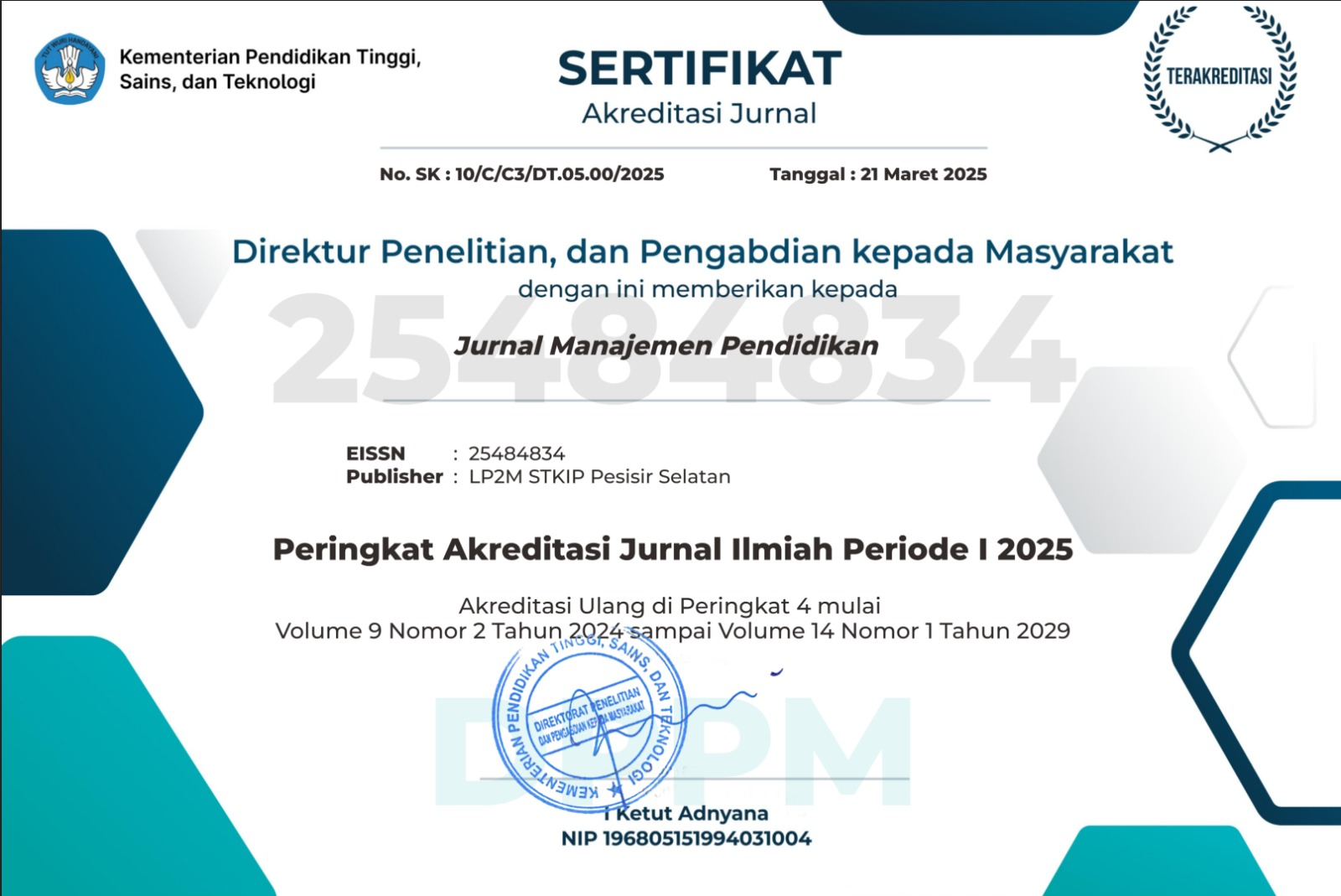
EKSPLORASI PEMBELAJARAN PENDIDIKAN AGAMA ISLAM BERPUSAT PADA PESERTA DIDIK DALAM MEMBANGUN PENGALAMAN DAN KETERLIBATAN BELAJAR DI SMP NEGERI 1 TALANG KELAPA
DOI:
https://doi.org/10.34125/jmp.v11i5.3682Keywords:
pembelajaran PAI; pembelajaran berpusat pada peserta didik; pengalaman belajar bermakna; keterlibatan belajar; nilai-nilai Islam.Abstract
Student-centered Islamic Religious Education (IRE) places students’ needs, experiences, potentials, and engagement as the foundation for meaningful learning. This study aims to analyze the implementation of student-centered IRE learning in developing students’ learning experiences and engagement at SMP Negeri 1 Talang Kelapa. This study employed a qualitative approach using a field research design. Data were collected through observations of the learning process, interviews with the IRE teacher and students, and documentation of learning materials and activities. Data were analyzed through data condensation, data display, and conclusion drawing, while data validity was strengthened through source and technique triangulation. The findings show that student-centered IRE learning was implemented through activities that encouraged students to ask questions, express opinions, engage in discussions, collaborate, relate learning materials to everyday experiences, and actively participate in learning tasks. Learning experiences became more meaningful when religious materials were connected to students’ daily contexts through interaction and reflection. Student engagement was reflected in active participation, confidence in expressing ideas, willingness to ask questions, and involvement in learning activities. Student-centered IRE learning supports meaningful learning experiences and encourages students to understand and actualize Islamic values in everyday life.
References
Anderson, L. W., & Krathwohl, D. R. (Eds.). (2001). A taxonomy for learning, teaching, and assessing: A revision of Bloom’s taxonomy of educational objectives. Longman. Library of Congress – A Taxonomy for Learning, Teaching, and Assessing
Bella, S., & Irawan, I. (2026). A culturally responsive PAI learning design: Integrating local Islamic wisdom through meaningful and engaging student participation. Abjadia: International Journal of Education, 11(1), 62–74. https://doi.org/10.18860/abj.v11i1.39893 Artikel Bella & Irawan (2026) – Abjadia
Biggs, J. B., & Tang, C. (2011). Teaching for quality learning at university: What the student does (4th ed.). McGraw-Hill/Society for Research into Higher Education/Open University Press. Google Books – Teaching for Quality Learning at University
Creswell, John W., and Cheryl N. Poth. 2018. Qualitative Inquiry and Research Design: Choosing Among Five Approaches. 4th ed. Los Angeles: SAGE Publications.
Fakhriah, N., & Oviyanti, F. (2026). Analisis teori belajar behavioristik dan implikasinya terhadap pembelajaran Pendidikan Agama Islam: A systematic literature review. JIIP: Jurnal Ilmiah Ilmu Pendidikan, 9(5), 5174–5182. https://doi.org/10.54371/jiip.v9i5.11371 Artikel Fakhriah & Oviyanti (2026) – JIIP
Hermawan, A. H., Nasir, T. M., Sabarudin, M., Sugiana, Y., Yasir, M., Mahmud, M., & Supendi, P. (2026). Integrating student-centered approaches in Islamic education: A case study of SMPN 1 Kadipaten, Indonesia. AL-ISHLAH: Jurnal Pendidikan, 18(1). Artikel Hermawan et al. (2026) – AL-ISHLAH
Joyce, B., & Calhoun, E. (2024). Models of teaching (10th ed.). Routledge. Routledge – Models of Teaching, 10th Edition
Junita, T., Oviyanti, F., & Sukirman. (2022). Penerapan strategi PBAS (Pembelajaran Berorientasi Aktivitas Siswa) dalam meningkatkan hasil belajar. Jurnal PAI Raden Fatah, 4(3), 239–252. https://doi.org/10.19109/pairf.v4i3.7799 Artikel Junita, Oviyanti, & Sukirman (2022) – Jurnal PAI Raden Fatah
Lincoln, Yvonna S., and Egon G. Guba. 1985. Naturalistic Inquiry. Beverly Hills, CA: SAGE Publications. Buku ini secara khusus membahas trustworthiness dan member checking dalam penelitian naturalistik/kualitatif.
Miles, M. B., Huberman, A. M., & Saldaña, J. (2014). Qualitative data analysis: A methods sourcebook (3rd ed.). SAGE Publications. SAGE – Qualitative Data Analysis
Miles, Matthew B., A. Michael Huberman, and Johnny Saldaña. 2014. Qualitative Data Analysis: A Methods Sourcebook. 3rd ed. Los Angeles: SAGE Publications.
Mishra, P., & Koehler, M. J. (2006). Technological pedagogical content knowledge: A framework for teacher knowledge. Teachers College Record, 108(6), 1017–1054. https://doi.org/10.1111/j.1467-9620.2006.00684.x Mishra & Koehler (2006) – TPACK
Oviyanti, F. (2013). Inovasi pembelajaran PAI dengan pengembangan model constructivism pada jenjang pendidikan dasar dan menengah. Ta’dib: Jurnal Pendidikan Islam, 18(1), 107–134. https://doi.org/10.19109/td.v18i01.42 Artikel Oviyanti (2013) – Ta’dib UIN Raden Fatah
Oviyanti, F., Maryamah, Sartika, A., Sanjaya, C. R., & Supriyadi. (2024). Analysis of student learning difficulties in Islamic Religious Education (PAI) subjects. EDUTEC: Journal of Education and Technology, 7(3), 548–555. https://doi.org/10.29062/edu.v7i3.782 Artikel Oviyanti et al. (2024) – EDUTEC
Oviyanti, F., Nurlaila, & Mabruroh. (2026). Strengthening the pedagogical competence of Islamic Religious Education (PAI) teachers: Mentoring preparation of contextual and deep learning-based teaching modules in Banyuasin Regency. Unram Journal of Community Service, 7(1), 98–102. https://doi.org/10.29303/ujcs.v7i1.1505 Artikel Oviyanti, Nurlaila, & Mabruroh (2026) – Unram Journal of Community Service
Oviyanti, F., Nurlaila, & Mabruroh. (2026). Transformasi pembelajaran abad ke-21 melalui modul ajar kontekstual dan deep learning. Insan Cendekia Palembang.
Ramayulis. (2002). Ilmu pendidikan Islam. Kalam Mulia. Google Books – Ilmu Pendidikan Islam
Rohmadi, R., & Yupi, M. N. (2023). Konsep pendidikan Islam inklusif perspektif KH. Abdurrahman Wahid. Moderatio: Jurnal Moderasi Beragama, 3(2), 147–158. https://doi.org/10.32332/moderatio.v3i2.7532 Artikel Rohmadi & Yupi (2023) – Moderatio
Rohmadi, R., Fadil, A., Zain, Z. F. S. C., & Soraya, N. (2025). The Ngobeng tradition in Palembang: Implementing local wisdom and religious moderation in multicultural education to achieve social harmony. Muslim Heritage, 10(1), 31–53. https://doi.org/10.21154/muslimheritage.v10i1.10874 Artikel Rohmadi et al. (2025) – Muslim Heritage
Rohmadi, R., Ibrahim, D., & Munir, M. (2024). Model of internalization of religious moderation values in Salafiyah boarding schools. Al-Hayat: Journal of Islamic Education, 8(3), 950–965. Al-Hayat: Journal of Islamic Education
Saifullah, M. I., Putri, I. J., Izzatuzzahroh, Mansur, A., & Anggara, B. (2026). Desain pembelajaran PAI berbasis Student Centered Learning (SCL) di era digital. Idarah Tarbawiyah: Journal of Management in Islamic Education, 7(3), 756–765. https://doi.org/10.32832/itjmie.v7i3.23193 Artikel Saifullah et al. (2026) – Idarah Tarbawiyah
Schunk, D. H. (2021). Learning theories: An educational perspective (8th ed.). Pearson. Pearson – Learning Theories, 8th Edition
Supriyadi, A., Hawi, A., & Oviyanti, F. (2021). Kompetensi guru PAI dalam menyusun rencana pelaksanaan pembelajaran (RPP) di MI Istiqomah Sekayu. Muaddib: Islamic Education Journal, 4(1), 37–43. https://doi.org/10.19109/muaddib.v4i1.10664 Artikel Supriyadi, Hawi, & Oviyanti (2021) – Muaddib
Suwartin, E., Fikriyah, A., Oviyanti, F., & Marlina, L. (2026). Student-centered learning dalam pembelajaran Pendidikan Agama Islam untuk membentuk karakter Islami peserta didik. PESHUM: Jurnal Pendidikan, Sosial dan Humaniora, 5(4). https://doi.org/10.56799/peshum.v5i4.19215 Artikel Suwartin et al. (2026) – PESHUM
UNESCO. (2023). Quality learning. UNESCO. UNESCO – Quality Learning
Woolfolk, A. (2021). Educational psychology (14th ed.). Pearson. Pearson – Educational Psychology, 14th Edition